Friday, 29 May 2026

Integration aims to make food distribution transparent, leak-proof and beneficiary-centric
In a landmark move blending financial innovation with welfare delivery, the Government of India has launched a Central Bank Digital Currency (CBDC)-based Digital Food Currency pilot in Gujarat, marking the first integration of programmable digital money into the Public Distribution System (PDS).
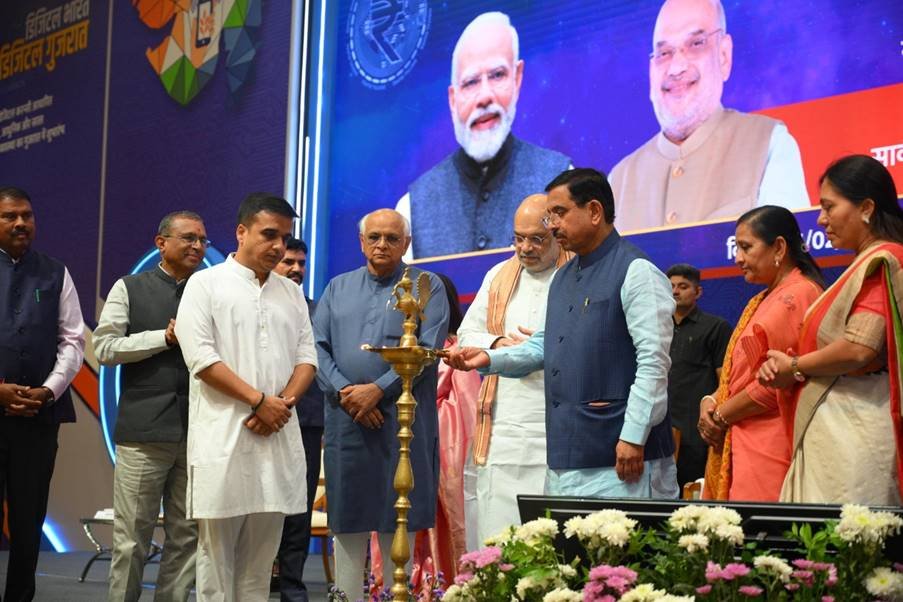
The pilot was inaugurated by Amit Shah in the presence of Prahlad Joshi, Union Minister for Consumer Affairs, Food and Public Distribution, and Bhupendra Patel, along with senior state and central officials.
CBDC Integration: A Structural Upgrade to India’s Food Security Architecture
Describing the initiative as a milestone reform, Prahlad Joshi said that integrating CBDC into the PDS architecture represents a decisive step toward transparency, efficiency and beneficiary empowerment. India’s PDS — the world’s largest food distribution network — serves over 80 crore beneficiaries. With the launch of the Digital Food Currency pilot, the government aims to further modernize the system through technology-led governance.
Under the new framework, digital coupons generated via the Reserve Bank of India will be credited directly to beneficiaries as programmable digital rupee (e₹). These coupons can be redeemed at Fair Price Shops (FPS) using QR codes or voucher codes for entitled foodgrain quantities. The programmable nature of the digital rupee ensures that funds can be used exclusively for foodgrain transactions, thereby minimizing misuse and enhancing accountability.
Addressing Biometric and Operational Challenges
Officials indicated that the CBDC-enabled system will reduce dependence on repeated biometric authentication and mitigate operational issues associated with e-POS devices. By generating a real-time, traceable digital trail of transactions, the platform enhances monitoring and oversight while simplifying the user experience for beneficiaries.
In addition, Fair Price Shop dealers will receive their margins in real time, improving cash flow efficiency and strengthening trust across the distribution chain. The digital wallet architecture ensures seamless transactions while reinforcing fiscal discipline within the system.
Pilot Rollout and Expansion Strategy
The pilot has been launched in collaboration with the Reserve Bank of India and the Government of Gujarat across selected districts — Ahmedabad, Anand, Valsad and Surat. Following its initial implementation, the program will expand to the Union Territories of Chandigarh, Puducherry, and Dadra & Nagar Haveli and Daman & Diu as part of a phased national rollout strategy.
Amit Shah described the initiative as an extension of the Digital India vision into welfare governance, noting that India now accounts for nearly half of the world’s digital transactions. He emphasized that CBDC integration aligns with the government’s “Minimum Government, Maximum Governance” approach by strengthening transparency and ensuring that beneficiaries receive their entitled foodgrains with greater awareness of their rights.
Building on a Decade of PDS Digitization
The CBDC pilot builds upon extensive digital reforms undertaken by the Department of Food and Public Distribution in recent years. These include end-to-end digitization of ration cards, nationwide portability under the One Nation One Ration Card (ONORC) framework, Aadhaar-enabled e-POS authentication, and real-time supply chain monitoring through platforms such as Ann Chakra. Grievance redressal systems like Ann Sahayata have further strengthened citizen-centric accountability.
By embedding a sovereign digital payment layer into the PDS, the government is effectively closing the loop between entitlement, authentication, transaction and audit.
A New Template for Welfare Delivery
The pilot, which currently covers a limited number of beneficiaries, is positioned as a proof-of-concept for integrating programmable digital currency into large-scale welfare systems. If successful, it could redefine subsidy delivery mechanisms by replacing traditional cash or in-kind transfer inefficiencies with a secure, traceable and purpose-bound digital alternative.
With the slogan “Har Dana, Har Rupiya, Har Adhikar,” the initiative seeks to ensure that every grain, every rupee and every entitlement reaches its intended beneficiary. As the pilot scales up, it may offer a replicable governance model for other social protection schemes, positioning India at the forefront of digital public infrastructure innovation in welfare administration.