Sunday, 21 June 2026

With Indian agriculture under strain from unpredictable weather, shrinking water resources, and deteriorating soil, Somaiya Vidyavihar University is charting a new course in how it trains future engineers to address these urgent needs.
The AgriTech Hackathon 2025–26 reflected this shift, encouraging students to find solutions not just through theory but through direct dialogue with farmers.
Led by K J Somaiya School of Engineering and organised by its Department of Electronics and Computer Engineering, in collaboration with the K J Somaiya Institute of Applied Agricultural Research (KIAAR), Karnataka, the two-phase national initiative was designed to build a meaningful bridge between Kisan (farmer) and Vigyan (technology). The hackathon highlighted the university’s goal of equipping students for life beyond campus. It placed practical learning, fresh ideas, and real-world problem-solving at the centre, showing what education aimed at tomorrow’s needs can deliver.
Innovation Begins in the Field
The Phase 1 hackathon at KIAAR in Karnataka took a fresh look at how new ideas take shape in agriculture. More than 40 student participants/teams skipped the usual list of questions and headed straight to the fields. There, they listened to 300+ farmers, met with agricultural scientists, and spoke with industry experts. Topics ranged from protecting soil and improving irrigation to fighting crop disease, making better use of nutrients, forecasting harvests, and finding ways to farm that last. The exchange of ideas led to 26 problem statements rooted in what farmers encounter every day.
The AgriTech Hackathon brought together Dr P L Patil, Vice Chancellor of the University of Agricultural Sciences, Dharwad, along with key figures from top agricultural universities, Godavari Biorefineries Limited, research institutes, and the farming community, demonstrating the real impact of working together for the future of agriculture.
“This partnership kept innovation closely tied to real agricultural needs,” said Dr Nandkumar Kunchge, Director at K J Somaiya Institute of Applied Agricultural Research (KIAAR). “By involving farmers, researchers, and students throughout the process, we increased the likelihood that the solutions developed would be genuinely useful and endure over time.”
From Insight to Application
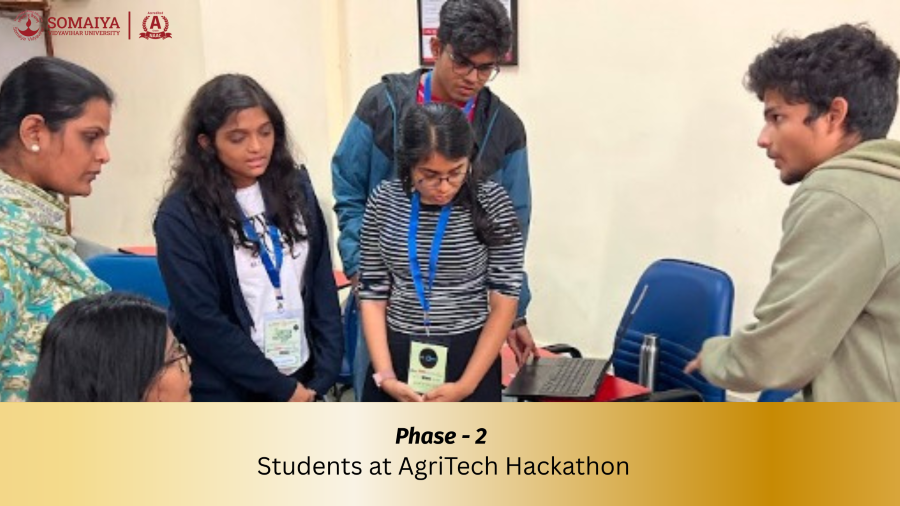
The second phase took place at the Somaiya Vidyavihar University campus in Mumbai. Students drew on fieldwork to tackle everyday problems faced by farmers. Over the course of 24 hours, teams from different parts of India worked within genuine constraints, designing agri-tech solutions for irrigation, disease detection, nutrient management, yield prediction, sensor applications, and sustainable farming methods.
Participants worked side by side, addressed problems as they came up, and developed solutions with a clear, lasting impact.
Learning from Knowledge Rooted in Nature
The hackathon reached its peak in the presence of our Chief Guest, Rahibai Soma Popere, recipient of the Padma Shri and Nari Shakti awards and widely known as the ‘Seed Mother of India’, who addressed the audience. Drawing on a lifetime of practical experience, she told the story of her rise from hardship to become a leader in preserving India’s native seeds. Nature, she said, has been her greatest teacher.
She cautioned against relying too much on chemical pesticides and hybrid crops, warning that declining soil health can affect entire communities and public well-being. She captured the essence of the hackathon by reminding everyone that real advances in technology start with respect for the natural world and a promise to pursue sustainability.
Educating Engineers for Societal Impact
Dr Suresh Ukarande, Dean and Director of K J Somaiya School of Engineering, shared his thoughts on the effort. “The AgriTech Hackathon shows the direction engineering education needs to take. When students listen to farmers and work with real constraints, they gain more than technical skills; they learn responsibility and develop a broader view.”
Recognising Purpose-Driven Student Innovation
The hackathon concluded with the awards ceremony recognising solutions that combined technical rigour with practical relevance. A Special Award for the Best Women-Led Team was presented to Team Weble, while Team Black 2.0 received the *Best Hardware Implementation Award. Mad Tech and Kisan Setu were also recognised for their application-oriented hardware solutions.
In the main competition category, Team Kronix secured third place, Team Troubleshoot and Team Circuit 25 jointly won second place, and the first prize was awarded to Team Snack Overflow from D J Sanghvi College of Engineering. The team’s winning idea was a tractor-mounted sprinkler system designed to reduce water waste and improve irrigation, two problems farmers in India face year after year.
Somaiya Vidyavihar University emphasises that true learning happens beyond the classroom. The AgriTech Hackathon 2025–26 put this into practice by sending students into actual fields to work alongside farmers, creating solutions that tackle genuine agricultural problems.