Friday, 12 June 2026

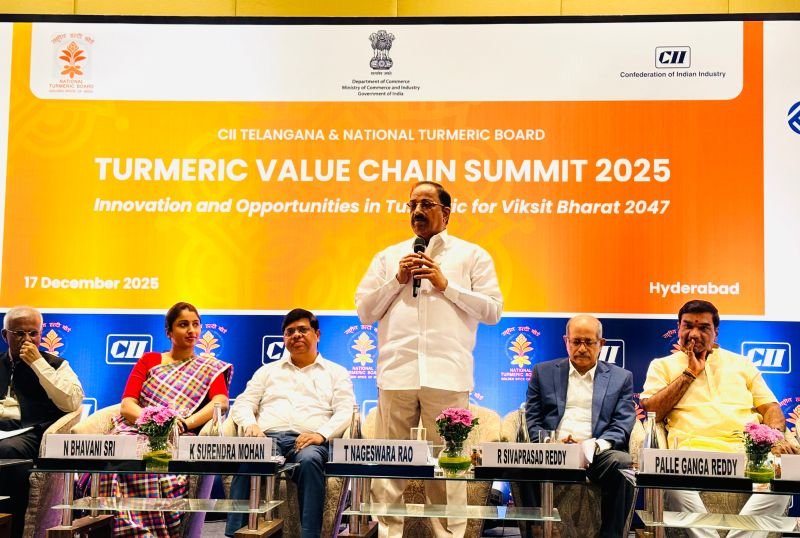
India’s turmeric economy—long anchored in bulk production and traditional trade—may be on the cusp of a strategic reset. That message dominated discussions at the maiden Turmeric Value Chain Summit 2025, organised by CII Telangana in collaboration with the National Turmeric Board, which brought together more than 200 policymakers, industry leaders, researchers, processors, exporters, and turmeric farmers in Hyderabad.
Held under the theme “Innovation & Opportunities in Turmeric for Viksit Bharat 2047,” the summit positioned turmeric not merely as a spice crop, but as a high-potential agri-industrial and nutraceutical ingredient capable of delivering higher farm incomes, export growth, and global brand leadership for India.
Farmer-first growth and institutional backing
Opening the summit, Tummala Nageswara Rao, Minister for Agriculture & Cooperation, Government of Telangana, underscored the state’s commitment to supporting the National Turmeric Board, which is headquartered in Telangana. He emphasised that all policy and market interventions must be designed with farmers at the centre, ensuring income stability, risk mitigation, and long-term profitability.
Highlighting the need to blend modern technology with traditional farming practices, the minister noted that turmeric offers strong potential as an intercrop, including in palm oil plantations, while also aligning with broader goals of strengthening horticulture, vegetable cultivation, and forest regeneration.
Why turmeric now has its own national board
Palle Ganga Reddy, Chairman, National Turmeric Board, pointed out that turmeric is the only spice among India’s 53 spices to have a dedicated national board, reflecting its economic, cultural, and export significance. India cultivates turmeric across nearly 8 lakh acres, with Telangana accounting for close to 60,000 acres in practice.
He called for scientific studies to map turmeric’s expanding applications, alongside stronger dissemination of best practices to farmers—particularly through major turmeric mandis such as Nizamabad, Metpally and Mahabubabad—and upgraded infrastructure at market committees.
From volume to value: Telangana’s strategic role
K Surendra Mohan, Secretary, Department of Agriculture & Cooperation, Government of Telangana, outlined how the state’s Vision 2047 places farmer welfare at the centre of growth. Telangana currently produces around 10 percent of the world’s turmeric, accounting for 1.12 lakh metric tonnes cultivated by over 40,000 farmers.
He stressed that while GDP growth remains important, farmer income growth must be a parallel priority, with farmer producer organisations (FPOs), value addition, organic and natural farming, and export-oriented processing as key levers.
Quality, compliance, and global competition
Addressing the competitive landscape, N Bhavani Sri, Secretary, National Turmeric Board, highlighted that India supplies over 70 percent of global turmeric demand, but faces increasing competition from Vietnam, Myanmar, and African producers. Future leadership, she noted, will depend on improving curcumin content, reducing moisture levels below 10 percent, and aligning output with international quality standards.
She emphasised the importance of continuous engagement between food processors and farmers to close quality gaps and strengthen export readiness.
Industry’s call for supply chain transformation
From an industry perspective, R Sivaprasad Reddy, Chairman, CII Telangana, described the establishment of the National Turmeric Board in Telangana as a structural boost for the sector, particularly for key trading hubs such as Nizamabad.
Dr V Praveen Rao, Adviser to CII Telangana’s Agri & Food Processing Panel and Vice-Chancellor of Kaveri University, framed the challenge more broadly: India must transition turmeric from a bulk commodity to a high-value ingredient, from fragmented trade to quality- and compliance-driven supply chains, especially as demand grows in pharma, nutraceuticals, and functional foods.
Curcumin, compliance, and PPP models
Echoing this shift, M Jayasankar M, Head – Strategic Sourcing, Agronomy & Sustainability at Synthite Industries, highlighted the need for stable, high-curcumin production, deeper public-private partnerships, and backward integration. He flagged pesticide residues as a critical challenge, particularly as curcumin increasingly feeds into pharmaceutical applications and regulated export markets.
Building credible, traceable supply chains, he noted, will be central to India’s ability to command premium positioning globally.
A spice with strategic weight
The Turmeric Value Chain Summit 2025 concluded with a clear consensus: turmeric is no longer just a cultural staple or export commodity. It is a strategic crop at the intersection of agriculture, health, trade, and rural development. Aligning farmer incentives with quality, science, and global standards will determine whether India can convert its dominance in volume into leadership in value.