Saturday, 18 July 2026

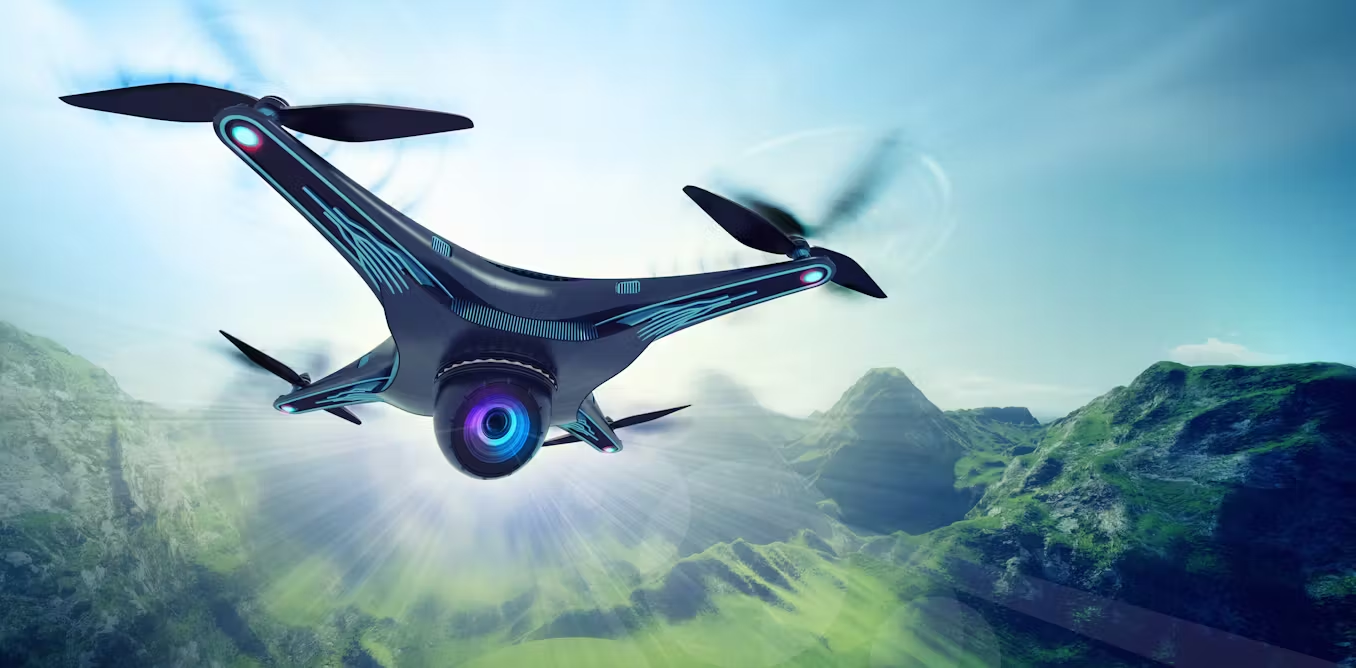

India’s agrarian panorama is witnessing a silent metamorphosis, orchestrated not by the plough but by propellers, observes Agnishwar Jayaprakash, Founder and CEO of Garuda Aerospace. The NaMo Drone Didi initiative, an ingenious amalgam of social emancipation and technological modernity, has transfigured rural women into airborne entrepreneurs, deftly uniting gender empowerment with the imperatives of precision agriculture. Bolstered by subsidies under the Sub-Mission on Agricultural Mechanization, concessional financing via the Agriculture Infrastructure Fund, and domestic incentivisation through the PLI scheme, this aerial revolution is no longer the preserve of affluent agrarians but increasingly within the grasp of smallholders. The dividends extend well beyond efficiency: drones obviate the perils of toxic pesticide exposure, usher in data-driven agronomy, optimise resource utilisation, and simultaneously enhance yields, conserve water, and curtail chemical excess. While the current fleet of some 3,000 agri-drones may appear numerically modest, projections of a $120 million market by 2030 at a brisk 25 per cent CAGR suggest that the ascent has only just begun. For Jayaprakash, these contraptions are not mere machines but veritable catalysts of empowerment, auguring a future in which rural India ascends on the twin wings of innovation and sustainability, with technological resilience as its lodestar.
In the panorama of India’s agricultural transformation, a silent yet profound revolution is taking flight. As the founder of an agri-drone enterprise, I have had a front-row seat to this technological renaissance, witnessing how drones are not merely tools but catalysts for rural empowerment. This movement, propelled by visionary government policies and the inherent ingenuity of our farmers, is charting a new course for Indian agriculture, one that is both sustainable and equitable. The integration of Unmanned Aerial Vehicles (UAVs) into farming practices is more than just an innovation; it is a strategic imperative to secure India’s food future and uplift its agrarian communities.
The cornerstone of this change is the ‘NaMo Drone Didi’ scheme, an initiative that transcends the traditional boundaries of technological adoption. This program, conceptualized by the government, is a masterstroke in social engineering, intertwining advanced technology with the empowerment of rural women. By providing drones and comprehensive operational training to women from Self-Help Groups (SHGs), the scheme is dismantling conventional gender roles in agriculture and forging a new cohort of tech-savvy entrepreneurs. These ‘drone didis’ are emerging as local service providers, offering critical drone-based services such as targeted spraying and crop monitoring to their communities.
This initiative is a powerful testament to the government’s commitment to addressing the dual challenges of technological access and women’s economic upliftment. It is creating a virtuous cycle of positive change, where women’s newfound economic independence is bolstering household incomes and driving community development, while simultaneously accelerating the adoption of precision farming techniques.
The success of the ‘NaMo Drone Didi’ scheme is underpinned by a robust framework of government initiatives and financial incentives designed to make drone technology accessible to all. The Ministry of Agriculture & Farmers Welfare, in collaboration with the Ministry of Civil Aviation, has been instrumental in creating a conducive policy environment. Key among these is the Sub-Mission on Agricultural Mechanization (SMAM), which offers substantial financial assistance for the acquisition of drones. This program is particularly beneficial for small and marginal farmers, as well as women and SC/ST farmers, who can avail a subsidy of up to 50 per cent of the drone’s cost, capped at Rs 5 lakh. Other farmers are eligible for a subsidy of up to 40 per cent, or Rs 4 lakh.
These subsidies are critical, as the initial capital outlay for a high-quality drone can be a significant deterrent for many farmers. Furthermore, the Agriculture Infrastructure Fund (AIF) provides low-interest loans for agri-infrastructure projects, including drone purchases, while the Production-Linked Incentive (PLI) Scheme supports domestic drone manufacturing, thereby reducing costs and fostering self-reliance. These synergistic policies are not just about providing financial aid; they are about building a sustainable ecosystem that encourages local innovation and reduces dependency on foreign technology, a vital step towards an ‘Atmanirbhar Bharat’.
The benefits of integrating drones into agricultural practices are manifold and extend far beyond mere operational efficiency. Drones are the vanguard of precision agriculture, enabling farmers to transition from traditional, resource-intensive methods to a data-driven approach. A key advantage is the unparalleled efficiency of drone-based spraying. A drone can spray an acre of land in a matter of minutes, a task that would consume several hours of manual labor. This speed not only saves valuable time but also ensures a uniform and precise application of pesticides and fertilizers.
By using the exact amount of chemicals required, drones can reduce wastage by up to 50 per cent, mitigating the environmental impact and lowering input costs for farmers. Furthermore, drones equipped with multispectral and thermal cameras provide farmers with a powerful diagnostic tool. They can conduct real-time crop health monitoring, identify pest infestations or nutrient deficiencies, and assess water stress with remarkable accuracy. This data allows for timely, targeted interventions, preventing crop damage and significantly boosting yields. The deployment of drones for irrigation management is also a game-changer, enabling farmers to optimize water usage and conserve this precious resource, a critical necessity in India’s water-stressed regions.
Beyond the economic and environmental benefits, drones are fundamentally transforming the safety and well-being of our farming communities. Manual spraying of pesticides is a hazardous task that exposes farmers to toxic chemicals, leading to a range of health issues. Drones eliminate this risk entirely by performing the task remotely, thereby safeguarding the health and longevity of our farm workers. This shift towards a safer and more mechanized farming environment is a crucial step towards making agriculture a more attractive and sustainable profession for future generations.
While the momentum is palpable, the journey towards widespread drone adoption is far from complete. As of today, the number of agri-drones in operation in India is estimated to be around 3,000, with projections indicating a rise to over 7,000 by the end of the next fiscal year. While this growth is encouraging, it is a modest number for a nation with over 140 million landholdings. The sheer scale of Indian agriculture necessitates a much more aggressive and strategic deployment of this technology. To meet this immense demand, we must focus on several key areas.
Firstly, we need to scale up our skill development and training infrastructure. While the ‘NaMo Drone Didi’ program is an excellent foundation, we need to establish more comprehensive and accessible training centers to certify a large workforce of skilled drone pilots and technicians. This will not only ensure safe and effective drone operation but also create a new wave of high-value employment opportunities in rural areas. Secondly, while subsidies have been effective, we must continue to innovate to make drone technology even more affordable and accessible. Fostering a robust network of Custom Hiring Centers (CHCs) and drone-as-a-service providers will be crucial to ensure that even the smallest farmers, who cannot afford to own a drone, can benefit from this technology.
Finally, we must continue to champion local innovation. Agri-tech startups in India are uniquely positioned to develop drones and software that are specifically tailored to the diverse and complex needs of our agricultural landscape, from varying crop types to diverse climatic conditions. Continued government and private sector support for this ecosystem will be vital for sustaining the momentum of this revolution.
This transformation is not a distant vision but a tangible reality unfolding across India’s diverse agricultural landscape. The rapid growth of the agri-drone market is a clear indicator of this shift. With a compound annual growth rate (CAGR) projected to exceed 25 per cent over the next five years, the market is poised to reach over $120 million by 2030. This growth is a direct result of a burgeoning ecosystem where government support, a vibrant startup community, and increasing farmer awareness are converging. This dynamic environment is fostering innovations that are specifically designed to address the unique challenges of Indian agriculture, such as fragmented landholdings, labor shortages, and the increasing impact of climate change.
Looking ahead, the future of agri-drones in India is intrinsically linked to the integration of advanced technologies. The next wave of innovation will see drones become even “smarter,” leveraging Artificial Intelligence (AI) and Machine Learning (ML) to provide more intelligent and efficient operations. AI-powered analytics will enable drones to not only capture data but also interpret it in real time, offering farmers actionable insights on crop health, soil conditions, and pest forecasting. This integration will lead to a more predictive and proactive farming model, where decisions are based on precise data rather than intuition. Swarm drones, for instance, are on the horizon, promising to scale operations across large farms by coordinating tasks like mass crop surveys and coordinated fertilizing, a crucial development for managing large agricultural areas efficiently.
In conclusion, the rise of agri-drones in India is more than a technological fad; it is a foundational shift that is reshaping the future of our agriculture. It is a story of empowerment, efficiency, and sustainability, driven by a powerful synergy between government vision, entrepreneurial spirit, and the indomitable will of our farmers. As we continue to build this ecosystem, we are not just deploying machines; we are building a more prosperous, resilient, and technologically advanced rural India. The future of Indian agriculture is indeed in the sky, and it is a future we are actively creating, one drone flight at a time.