Wednesday, 24 June 2026

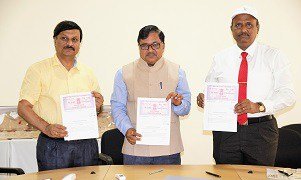
Dr Trilochan Mohapatra, Secretary (DARE) & DG (ICAR) recently chaired the CSISA-KVK collaborative Project Review on Monitoring, Evaluation and Learning through the Large Scale Diagnostic Survey. Dr Mohapatra applauded the observations made through the Large Scale Diagnostic Survey (LDS) of rice and wheat crops. He desired that five major recommendations which are revealed from the survey viz. impact of early sowing of wheat and rice, application of nutrients, irrigation at critical stages, etc., may be brought out from Wheat and Rice Surveys. The Director-General stressed taking-up the recommendations with the Department of Agriculture, Cooperation & Farmers’ Welfare, Ministry of Agriculture & Farmers’ Welfare, Government of India for the different regions and states.
Dr Mohapatra emphasized taking-up such surveys in horticulture, dairy and fisheries sectors too. He stressed harnessing the KVK’s strength. The Director-General also released the Publication “New Frontiers in Agricultural Extension” – Volume – II based on LDS for rice crop during the occasion.
Dr Ashok Kumar Singh, Deputy Director General (Agricultural Extension), ICAR outlined the adoption Patterns of different varieties in rice. He underlined that the older varieties, such as, MTU 7029 (Swarna) released in 1982 and BPT 5204 (Samba Mahsuri) released in 1986 continue to dominate the Eastern India region. The Paddy yields in Bihar and Eastern Uttar Pradesh were just half to that of Punjab and Haryana within the same maturity class.