Tuesday, 14 July 2026

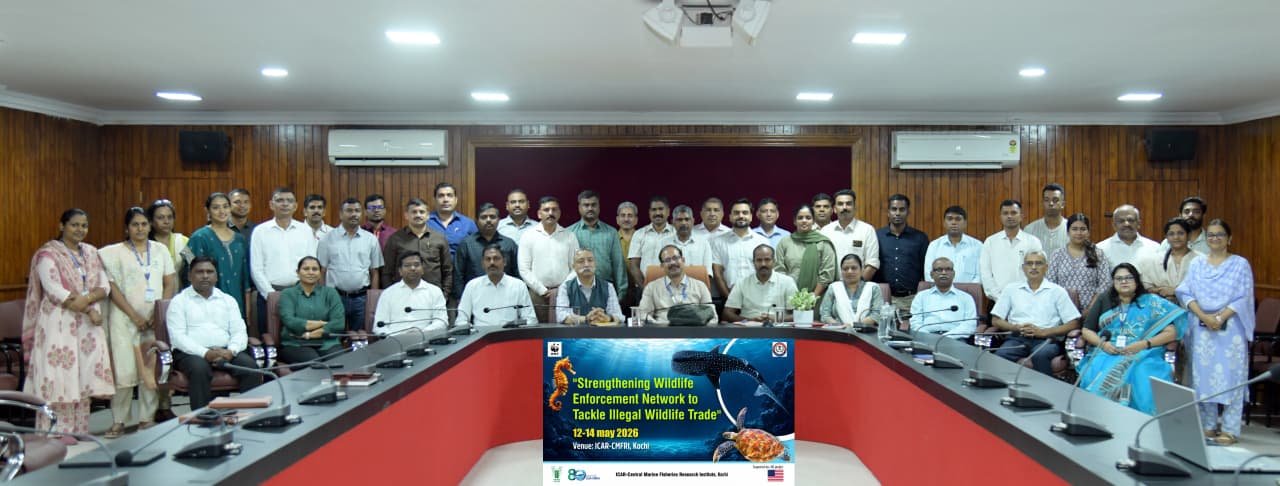
CMFRI hosts national capacity building meet to strengthen wildlife enforcement against illegal wildlife trade
In view of the increasing threat from illegal marine species trade, experts have called for an integrated conservation framework, including community participation, to strengthen marine enforcement. Speaking at a national capacity building workshop being held at ICAR-Central Marine Fisheries Research Institute (CMFRI), they called for a holistic approach combining science, enforcement, policy support and community engagement.
The three-day workshop, jointly organised by CMFRI, Wildlife Crime Control Bureau (WCCB) and WWF-India, brought together 27 enforcement officials representing forest department, postal department, railway protection force, police of west coast states and UT Lakshadweep along with scientists, conservationists and policymakers from across the country.
Emphasising the need for coordinated action against illegal wildlife trade in the marine sector, the meeting observed that effective conservation requires continuous monitoring, stronger stakeholder engagement and transparent dialogue with fishing communities. According to experts, this is critical to address misconceptions surrounding conservation of marine resources, especially with recently amended wildlife protection act.
Citing relevant studies, the workshop highlighted that between 2010 and 2022, India recorded 17 incidents involving seizures of illegal shark derivatives, with shark fins accounting for nearly 82 per cent of the total seizures. About 15,839.5 kilograms of shark derivatives were confiscated during the period, with Tamil Nadu emerging as a major hotspot accounting for nearly 65 per cent of the incidents.
In his inaugural address, Divisional Forest Officer (DFO) Manu Sathyan said species identification was one of the biggest challenges faced by enforcement agencies in marine wildlife crime investigations. He stressed the need for closer collaboration with research institutions like CMFRI for scientific identification and documentation of protected marine species.
CMFRI Director Dr Grinson George stressed the need for a robust enforcement network to tackle illegal marine wildlife trade and ensure conservation. Emphasising the importance of proper legislation in line with societal needs and ecosystem requirements, he said technology-driven approach would help step up surveillance and enforcement.
Senior Director of Biodiversity Conservation, WWF-India Dr Dipankar Ghose stated that illegal trade in marine species must be dealt differently from trade in terrestrial species. It needs a deeper understanding of fishers’ livelihoods, motivation for IWT and together with stakeholders, finding solutions to curb this trade.
CMFRI’s Finfish Fisheries Division Head Dr Shoba Joe Kizhakudan said marine conservation in India could not be treated merely as a wildlife issue, but must also be viewed as a fisheries and livelihood issue affecting coastal communities dependent on marine resources. “Consultation and dialogue with fishermen are essential for smooth enforcement and long-term conservation success”, she added.
In response to the growing threat of illegal trade, CMFRI has been extending scientific support to regulatory and enforcement agencies through rapid identification, forensic identification of shark fins and other marine derivatives intended for export, Dr Shoba said.
The three-day meet focuses on improving enforcement mechanisms, species identification, legal procedures, digital evidence collection and inter-agency coordination to combat wildlife crime. Sessions are being handled by experts from CMFRI, WWF-India, WCCB, Wildlife Institute of India (WII), Dakshin Foundation, and Kerala Fisheries Department. Topics include identification of corals, molluscs, marine mammals, turtles and elasmobranchs, digital evidence collection in wildlife cybercrime, and marine fisheries regulation.