Wednesday, 15 July 2026

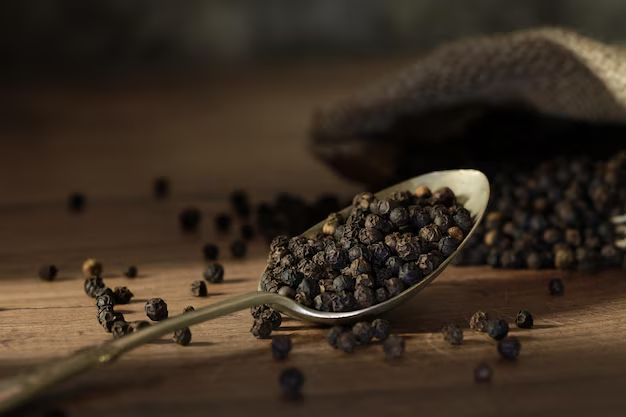
Premium grades touch Rs 80,000 per Quintal as Kerala leads high-value trade while Karnataka drives volumes
India’s black pepper markets recorded sharp price variations and regionally concentrated arrivals between April 12 and April 13, 2026, reflecting a dynamic interplay between quality grades, supply volumes, and localized demand patterns across key producing states.
According to the latest Daily Price Arrival Report, modal prices for black pepper ranged widely from Rs 40,000 to Rs 80,000 per quintal, with premium garbled varieties in Kerala commanding the highest valuations. At the same time, Karnataka continued to dominate in terms of arrival volumes, indicating a divergence between volume-driven and value-driven markets.
In Karnataka’s Chikmagalur district, Moodigere APMC emerged as a major trading hub with significant arrivals of 65.80 metric tonnes on April 12, where modal prices were recorded at Rs 40,000 per quintal despite a maximum price touching Rs 70,117. A day later, on April 13, arrivals dropped sharply to 14.10 metric tonnes, but modal prices surged to Rs 70,069 per quintal, highlighting short-term price corrections driven by tighter supply.
Similarly, Shimoga (Theertahalli) APMC reported a modal price of Rs 69,000 per quintal on April 13, albeit with minimal arrivals of just 0.30 metric tonnes, reinforcing the trend of strong pricing in low-volume, high-quality trades.
Kerala’s markets, particularly in Ernakulam and Idukki districts, continued to set the benchmark for premium pricing. At North Paravur APMC, garbled Grade Range-1 black pepper was traded at a modal price of Rs 80,000 per quintal, with prices ranging between Rs 75,000 and Rs 95,000. This segment reflects strong demand for high-quality, export-oriented produce.
In Idukki, a key production belt, Kattappana APMC reported ungarbled Grade Range-2 pepper at Rs 69,000 per quintal with arrivals of 3.00 metric tonnes, while Thodupuzha APMC recorded multiple trades across grades. Garbled pepper achieved Rs 80,000 per quintal, while other Grade Range-1 varieties were priced at Rs 65,200 and Rs 69,300 per quintal, albeit with limited arrivals of 0.20 metric tonnes per transaction.
Kannur markets presented a slightly softer pricing trend. Irikkur APMC recorded ungarbled local pepper at Rs 65,900 per quintal, while Payyannur APMC saw modal prices at Rs 64,000 per quintal for local varieties, supported by relatively higher arrivals of 2.00 metric tonnes.
The data underscores a clear segmentation within the black pepper market. High-grade, garbled pepper continues to command a significant premium, particularly in Kerala, where processing quality and export alignment remain strong. In contrast, Karnataka’s larger volumes are associated with more price variability, driven by mixed quality supplies and higher throughput.
Another notable trend is the inverse relationship between arrivals and prices across several markets. Lower arrival quantities, particularly in premium segments, are consistently linked to higher modal prices, indicating supply sensitivity and strong buyer competition for quality produce.
The sharp fluctuation in Moodigere APMC—from Rs 40,000 to over Rs 70,000 per quintal within a day—illustrates the market’s responsiveness to short-term supply changes. This volatility is further amplified by the fragmented nature of arrivals, where even small changes in volume can significantly influence pricing benchmarks.
From a broader market perspective, the report highlights the continued dominance of southern states in India’s black pepper trade, with Kerala leading in value realization and Karnataka anchoring supply volumes. The presence of multiple grades—garbled, ungarbled, and local—also reflects the layered nature of demand, spanning both domestic consumption and export markets.
Looking ahead, sustained price firmness in premium categories suggests strong underlying demand, particularly for export-grade pepper. However, the variability in lower-grade segments indicates that market stability will depend on consistent arrivals and quality standardization.
As India navigates evolving global spice trade dynamics, these regional price signals and arrival patterns will play a critical role in shaping procurement strategies, export competitiveness, and farmer price realization in the months ahead.