Wednesday, 15 July 2026

A chronicle of Mandi arrivals and price movements
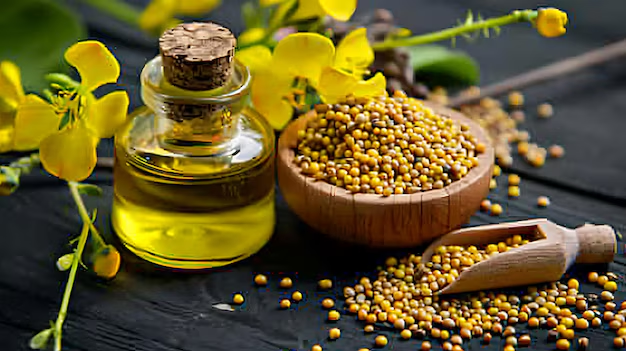
Rapeseed and mustard, the twin pillars of India’s edible oil economy, are more than crops—they are instruments of inflation management, farmer livelihood, and trade diplomacy. As the Rabi harvest flows into mandis across Rajasthan, Madhya Pradesh, Gujarat, Haryana, and Uttar Pradesh, the numbers tell a story of abundance tempered by volatility. Between 28 February 2026 and 30 March 2026, India’s mandis received 676,487 metric tons (MT) of rapeseed and mustard, with an all‑India average wholesale price of Rs 6,155.23 per quintal. This article dissects the data, state by state, mandi by mandi, to reveal the underlying dynamics shaping India’s oilseed narrative.
Rajasthan: The Heartland of Mustard
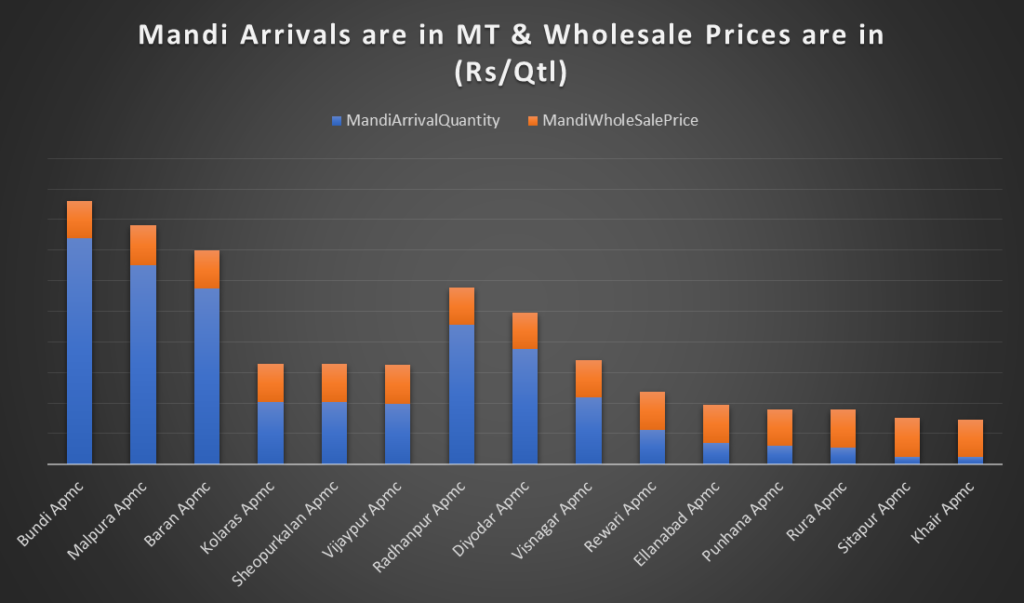
Rajasthan, the undisputed mustard capital, accounted for nearly half of India’s arrivals with 328,752 MT and an average wholesale price of Rs 6,190.55 per quintal. Its mandis displayed both volume and price diversity. Bundi APMC recorded 37,000 MT at Rs 5,962.55 per quintal, reflecting oversupply and weaker procurement activity. Malpura APMC, with 32,486 MT, commanded the highest price at Rs 6,534.86 per quintal, suggesting strong private demand or tighter arrivals.
Baran APMC, at 28,742 MT and Rs 6,157.73 per quintal, aligned closely with the state average, embodying Rajasthan’s equilibrium. The spread between Bundi and Malpura—over Rs 570 per quintal—illustrates intra‑state volatility that policymakers must address through storage and transport interventions. Rajasthan’s dominance underscores its role as the price setter in India’s mustard economy.
Madhya Pradesh: The Rising Challenger
Madhya Pradesh recorded 188,092 MT in arrivals with an average wholesale price of Rs 6,151.65 per quintal. Its key mandis showed remarkable consistency. Kolaras APMC reported 10,220 MT at Rs 6,230.74 per quintal, Sheopurkalan APMC registered 11,640 MT at Rs 6,310.63 per quintal, and Vijaypur APMC recorded 9,897 MT at Rs 6,305.95 per quintal.
Prices consistently hovered above Rs 6,200, reflecting strong demand and efficient procurement. Unlike Rajasthan, intra‑state price variation was minimal, suggesting better market integration. The state’s growing arrivals position it as a challenger to Rajasthan’s supremacy, particularly as farmers diversify into mustard to hedge against soybean volatility.
Gujarat: Stability with Slight Softness
Gujarat contributed 121,722 MT with an average wholesale price of Rs 6,054.49 per quintal. Its mandis revealed a softer pricing trend. Radhanpur APMC reported 22,843 MT at Rs 6,017.93 per quintal, Diyodar APMC recorded 18,811 MT at Rs 5,961.01 per quintal, and Visnagar APMC registered 10,992 MT at Rs 5,983.85 per quintal.
Prices were consistently below the national average, reflecting either weaker demand or higher arrivals relative to local consumption. Diyodar’s Rs 5,961.01 per quintal was among the lowest nationally, highlighting potential distress sales. Yet, Gujarat’s logistical advantage—proximity to ports—positions it strategically for mustard oil exports, offering opportunities to leverage global demand.
Haryana: Modest Arrivals, Competitive Prices
Haryana’s arrivals stood at 27,166 MT with an average wholesale price of Rs 6,162.08 per quintal. Rewari APMC reported 5,559 MT at Rs 6,237.12 per quintal, Ellanabad APMC recorded 3,485 MT at Rs 6,213.69 per quintal, and Punhana APMC registered 2,990 MT at Rs 5,886.65 per quintal.
Although arrivals were modest, prices remained competitive. Rewari and Ellanabad reflected strong demand, while Punhana’s lower price suggested localized oversupply. Haryana’s proximity to Delhi NCR ensures steady consumption, cushioning farmers against volatility and making the state a reliable contributor despite smaller volumes.
Uttar Pradesh: Small Volumes, Price Diversity
Uttar Pradesh contributed 8,455 MT with an average wholesale price of Rs 6,090.58 per quintal. Rura APMC reported 2,744 MT at Rs 6,157.86 per quintal, Sitapur APMC recorded 1,259 MT at Rs 6,386.16 per quintal, and Khair APMC registered 1,224 MT at Rs 6,102.87 per quintal. Although arrivals were the smallest among major states, prices showed diversity.
Sitapur’s Rs 6,386.16 per quintal was among the highest nationally, reflecting localized scarcity or strong private demand. This highlights the fragmented nature of mustard markets in smaller states, where local conditions can sharply influence price outcomes.
Comparative Insights: Price and Arrival Dynamics
Rajasthan dominates arrivals, but price volatility is high, with Bundi and Malpura showing stark contrasts. Madhya Pradesh demonstrates price stability, positioning itself as a rising mustard hub with consistent mandi performance. Gujarat’s prices are softer, but its export potential is strong, given its port connectivity. Haryana and Uttar Pradesh contribute modestly, yet their prices reflect localized dynamics that are critical to understanding the broader market. Together, these states form a mosaic of India’s mustard economy, each playing a distinct role in shaping national averages and farmer realization.
| State | Arrivals (MT) | Avg Price (Rs / Qtl) |
| Rajasthan | 328,752 | 6,190.55 |
| Madhya Pradesh | 188,092 | 6,151.65 |
| Gujarat | 121,722 | 6,054.49 |
| Haryana | 27,166 | 6,162.08 |
| Uttar Pradesh | 8,455 | 6,090.58 |
| All India | 676,487 | 6,155.23 |
Source: Agmarknet (via API)
The Oilseed Mosaic
The mandi comparison from late February to March 2026 reveals a sector in motion, where Rajasthan’s commanding scale, Madhya Pradesh’s growing stability, Gujarat’s export‑driven potential, and the distinctive dynamics of Haryana and Uttar Pradesh converge into a unified national tapestry. This is not merely a snapshot of arrivals and prices; it is a portrait of resilience and ambition—an economy that sustains households, moderates inflation, and asserts India’s presence in global trade.
The imperative is clear: transform mustard from a commodity into a strategic lever of national policy. By embedding resilience in production, equity in farmer returns, and foresight in logistics and trade, India can elevate its oilseed sector into a cornerstone of agricultural strength and global leadership. Mustard, once seen as a seasonal harvest, now stands as a symbol of India’s capacity to align local abundance with international influence.
— Suchetana Choudhury (suchetana.choudhuri@agrospectrumindia.com)