Tuesday, 14 July 2026

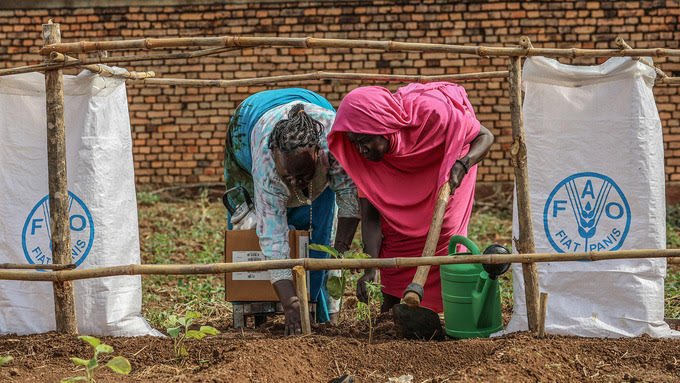
Photo courtesy: FAO/Adam Ibrahim
Three of the women farmers in South Sudan who are upholding and uplifting their community
The sun has yet to rise over the northwestern county of Wau in South Sudan, but the women are already awake, preparing for the day ahead. Some stir pots over open flames to make breakfast for their families, while others gather their tools and set off for their farms. The quiet stillness of early morning soon turns into a steady hum of activity as kitchens, fields and markets come alive with the energy of women at work.
Their daily responsibilities are not just feeding their families or tending to the crops, women are the backbone of their community
Over the past three years, the Food and Agriculture Organization of the United Nations (FAO), with funding from the Swedish International Development Cooperation Agency, has supported thousands of women farmers and small business owners in Wau with tools and skills in climate-smart agriculture, nutrition and financial inclusion.
Among them are three women, Rebecca, Grace and Viola, who turned knowledge and skills into businesses to feed their families and nourish their community.
Rebecca: Saving small and dreaming big
Rebecca Adhel, 34, is the head of a multigenerational household of sixteen. For years, she relied on sorghum production to meet her family’s basic needs.
Four years ago, Rebecca joined a Women’s Economic Empowerment group, established by FAO and through which the Organization’s experts provided trainings to woman farmers with entrepreneurial ambitions.
Rebecca, for example, had always wanted to start a bakery but lacked the capital to do so. The programme taught her and the larger group practical skills such as budgeting, marketing and record-keeping, as well as social skills, like team building, decision-making, negotiation and leadership that are important for entrepreneurship.
FAO also helped the women launch the Village Savings and Loans Association (VSLA), a community savings group where they pool their money and offer loans to members and non-members for essential expenses or capital for starting a business.
The VSLA was what also allowed Rebecca to take out a loan to start her business of selling freshly baked breads and cakes. With the income she earns from her business, she makes additional income to support her family while also being able to pay back her loan.
Rebecca voices, “I want to become one of the greatest businesswomen in Agok, so that I can help my community shift from small-scale to large-scale business.”
Grace: Living from livestock
Grace Ali Darfur heads a family of nine. Before joining the project, she relied on vegetable farming as her main source of livelihood. In 2022, she was introduced to the FAO project where she received training, vegetable seeds and tools to enhance and diversify her vegetable production.
However, the most significant impact came when she received goats for rearing. FAO distributed small ruminants to 2 100 women with children under the age of five who were experiencing malnutrition. Small ruminants such as goats and sheep help cushion farmers’ livelihoods during crop failures and provide both adults and children with milk for consumption, adding dietary diversity for the households.
“I feel so happy rearing livestock because they saved the life of my daughter,” Grace says. As her daughter struggled with malnutrition, Grace was advised to give her goat’s milk as a supplement. She soon saw her daughter’s health improve. “Now my daughter is happy and healthy,” Grace adds.
Beyond nutrition, her livestock has given Grace a new purpose. Employing the livestock-rearing best practices she learned from FAO, she tends to her goats while her children are at school. Neighbours now seek her advice and expertise on livestock rearing, and she, in turn, encourages them to get involved, having seen firsthand how it can help prevent malnutrition within the community.
Viola: Growing nutrition
Viola Albino, a 32-year-old farmer, is the primary breadwinner for her family of six. She was involved in small-scale agro-processing and farming before being introduced to the FAO project.
With FAO’s help, in 2022, she started her kitchen garden and business. Viola was trained in improved crop production and was provided seeds and tools to grow okra, amaranth, sorghum, Jew’s Mallow, cowpeas and more. She also participated in cooking demonstrations focused on preparing high-energy, nutrient-rich meals.
The vegetables she successfully grows now provide her family with a diverse, nutritious diet and benefit her household and her neighbours, who can buy fresh produce from her at a cheaper price instead of travelling long distances to the market.
She looks forward each day to visiting her kitchen garden, which brims with activity as it serves as a shared learning space where women exchange skills and apply agricultural practices while growing their vegetables. Looking ahead, Viola hopes to scale up production and become one of the major vegetable producers in her community.
Through improved agricultural practices, small businesses and better nutrition, Wau’s women farmers like Rebecca, Grace and Viola are transforming their lives and their community.
Click to read the full story : https://www.fao.org/newsroom/story/waus-women-sow-feed-and-lead/en