Tuesday, 7 July 2026

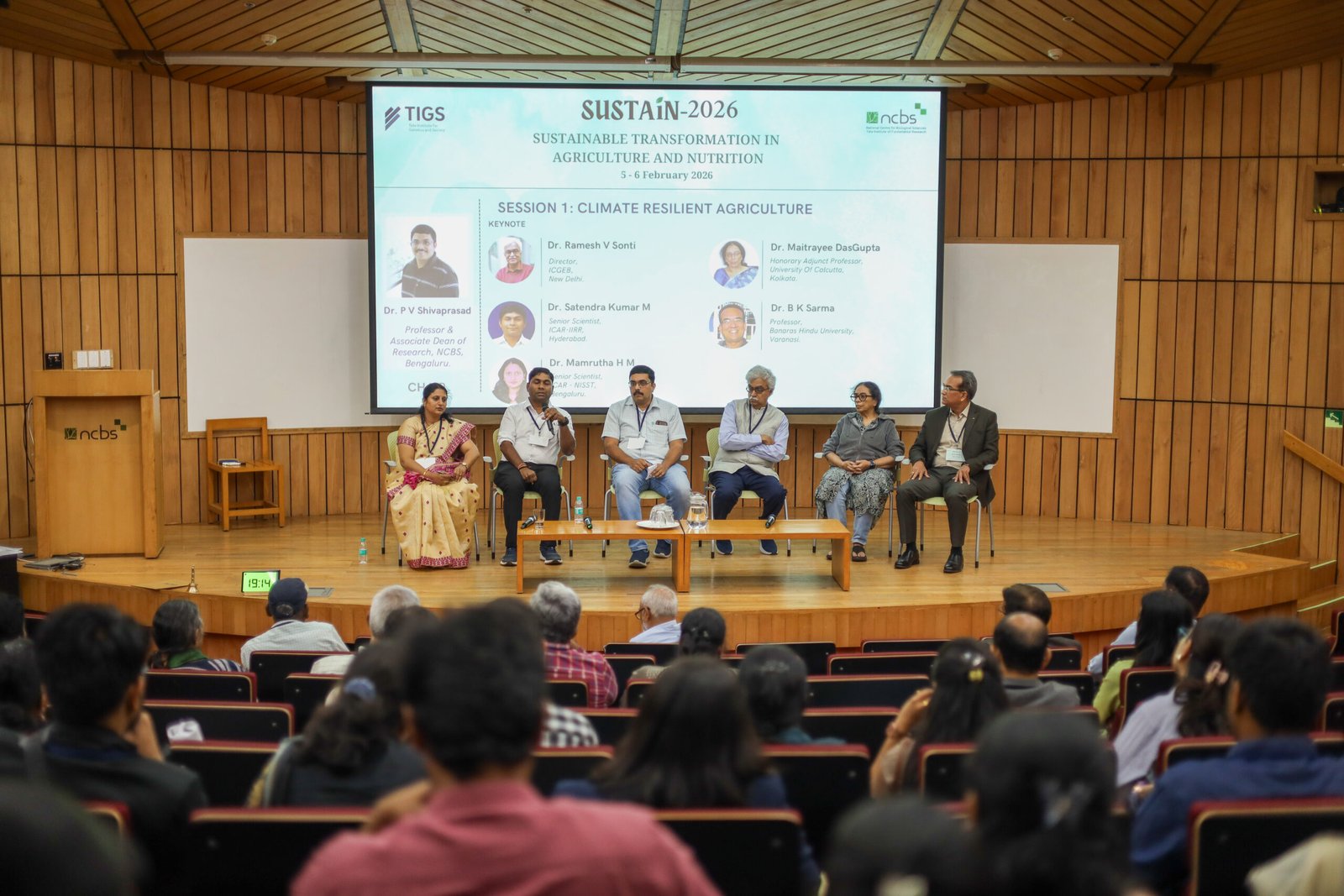
Sustainable Transformation in Agriculture and Nutrition Summit (SUSTAiN) 2026 held in February 2026, is an innovative flagship initiative launched by the Tata Institute for Genetics and Society (TIGS) in collaboration with the National Centre for Biological Sciences (NCBS)
SUSTAiN 2026 was envisaged to serve as a national platform to bring together researchers, policymakers, startups, and industry leaders for a multi-stakeholder engagement to shape the future of sustainable agriculture in India. This year, SUSTAiN fostered engaging dialogues and partnerships on climate-resilient agriculture, advanced pest management, and improved nutrition.
The University of Agricultural Sciences (UAS, GKVK) Bengaluru, ICAR-National Bureau of Agricultural Insect Resources (ICAR-NBAIR) Bengaluru, and ICAR-Indian Institute of Rice Research (ICAR-IIRR) Hyderabad extended their support as knowledge partners for the summit. SUSTAiN 2026 featured keynote talks from eminent scientists and startups, as well as expert panel discussions and poster sessions highlighting cutting-edge research and real-world applications.
The policy recommendations from SUSTAiN 2026 are structured across key pillars such as climate-resilient and low-emission crop systems, sustainable management of pest and emerging pesticide tolerance, wider adoption of biotechnology and data governance, nutrition-sensitive agricultural practices, and market-aligned innovation through structured public–private partnerships.
The discussions identified bottlenecks in regulatory and adoption pipelines of emerging technologies, slow research-to-market transition, and improper adoption of Integrated Pest Management (IPM). Further, the dialogues garnered emphasis that sustainability must be economically viable for farmers, and it calls for a shift from calorie-centric food security to nutrient-sensitive agriculture.
Climate Resilient Agriculture: Beyond Yield
As part of sustainable agriculture and reducing agricultural methane emissions, a key emphasis was placed on Direct Seeded Rice for reduction of water usage and methane emission. Direct Seeded Rice (DSR) incorporates traits such as anaerobic germination, seedling vigour, herbicide tolerance, and lodging resistance, which substantially lower methane emissions and improve crop establishment.
Marker-assisted backcross breeding helped in development of bacterial blight tolerant elite rice variety, Improved Samba Mahsuri, which was further improved with additional traits such as high yield, low phosphorus application, or tolerance to various stresses such as salinity, submergence, blast disease, lodging, pest, etc. At the genetic level, genome-edited rice variety significantly enhances the yield by reprogramming the cytokinin metabolism. This improves productivity, stronger culms, improved root systems, early harvest, and better tolerance to drought and low nitrogen application.
Nitrogen fertilizers remain one of the largest cost inputs in the agricultural industry. Future strategies using diverse microbial consortia and wild crop cultivars could develop self-fertilizing crops that substantially reduce the current fertilizer dependency. Parallelly, investing in microbial biocontrol and utilizing epigenetic regulation for stress management with region-specific agricultural solutions can sustainably improve soil-plant-microbe interactions for long-term productivity gains.
Furthermore, integrating multi-location and precision screening can accelerate the identification of adaptive traits and improve climate-resilient breeding. Physiological traits such as leaf waxiness, drooping leaf architecture, stomatal behavior, and photosynthetic efficiency are incorporated through frontier breeding.
Accelerated regulatory pathways for faster adoption of genome-edited crops and investment in synthetic microbial communities for plant growth and protection are crucial in integrating sustainability and emission reduction as part of agricultural policy. These steps can improve productivity, reduce dependence on chemical fertilizers, and lower greenhouse gas emissions from agriculture
Sustainable Pest Management
Sustainable pest management has become an increasingly difficult challenge owing to the development of resistance, invasion of new pests, and climate change. This has necessitated the policy makers to develop strong integrated and holistic pest control approaches, awareness campaigns, and capacity building for frontline workers and farmers for promoting ecological pest management practices.
Moving from reactive pesticide dependence to a proactive framework on Insecticide Resistance Management (IRM) is critical. It requires robust resistance monitoring, development of effective Insecticide Resistance Management strategies, judicious insecticide use, data-driven policies, farmer education, and adoption of non-chemical measures. Establishing regulatory frameworks on CRISPR-Based Pest Management and responsible deployment of genome editing technologies in agriculture requires careful balancing of scientific benefits, biosafety considerations, and societal acceptance.
Integration of pest forecasting systems with climate modeling tools for sustainable pest management would improve early warning capabilities, aligning with the broader climate resilient agriculture strategies.
Sustainable Nutrition Security
Sustainable nutrition security requires a strategic shift from food security to nutrient-sensitive agriculture. Strengthening of Indian agricultural policy from calorie security to nutrient security, bioavailability, nutrient density, and protein quality is crucial.
Improved policy support for biofortification and genomics-assisted multi-trait breeding are crucial steps in developing nutrient-sensitive agriculture. On the broader aim of sustainable nutrition management, investment in genomics-assisted selection, Quantitative Trait Loci mapping (QTL) mapping, and sophisticated nutrition quantification can accelerate the development of nutrient-sensitive and climate-resilient crops. Institutional Procurement of biofortified cereal varieties can play a major role in mainstreaming biofortified varieties and integrating them in Public Distribution System (PDS), Integrated Child Development Services (ICDS), and Mid-Day Meal schemes.
Operationalizing these frameworks requires intersectoral collaborations across plant breeders, molecular biologists, nutritionists, policymakers, startups, and extension systems. Institutionalizing nutrition-per-hectare metrics, introducing nutrient-linked MSP premiums, enabling mandi-level nutrition quantification, and integrating insurance incentives and consumer awareness campaigns across ministries can align agriculture, health, and food processing under a unified strategy that systematically embeds nutrition outcomes into production economics, market signals, and public policy decision-making.
Finally, Panel discussions pointed out the importance of transitioning Agricultural Research from core research to sustainable market solutions and integration of nutritional security with the current agricultural policy landscape. Public-Private Partnerships (PPPs) are a critical step toward strengthening collaborative platforms for shared intellectual property in genome-edited crops, climate-resilient varieties, microbial products, and biofortified crops to enable large-scale adoption. Behavioral and cultural dimensions of biofortified crops, including taste preferences, affordability, and local dietary practices, are important factors in policy design.
Multidisciplinary research teams and cross-sector partnerships in sustainability, climate resilience, pest management, biotechnology, and nutrition must adopt a farmer-centric innovation design.
Way Forward
SUSTAiN 2026 brought to light the need for proper regulatory pathways for faster adoption of genome-edited crop and pest control technologies. There is a need for strengthened inter-ministerial coordination for the faster deployment of newer crop varieties. Adoption of low-emission crop systems like Direct Seeded Rice (DSR) varieties as part of agricultural policy, aligning improved productivity with climate-resilient agriculture, strengthening multi-location climate screening and testing across different climate zones to identify the stress tolerance and adaptive traits of crops, is the need of the hour.
There is a need for capacity building sessions enabling farmers to adopt Integrated Pest Management (IPM) as a proactive ecological pest control strategy supported by the insecticide resistance monitoring systems. Shifting of the agricultural policy from calorie security to nutrient-sensitive agriculture, emphasizing more on nutrient density, bioavailability, and protein quality. Aligning agricultural productivity as nutrient per hectare metrics can improve public health outcomes.
Establishing proper Public-Private Partnership (PPP) platforms for shared intellectual property, technology transfer, and large-scale market adoption of climate-resilient and nutrition-sensitive innovations would be critical for faster research-to-market transition
Furthermore, adoption of farmer-centric innovations and cross-sectoral collaborations across the sectors of sustainability, climate resilience, pest management, and nutrition is crucial in aligning sustainable agriculture with productivity goals and nutritional demands of the population.
Authors: Aswin Sreekumar, Saveetha Meganathan, Kamal Kumar Malukani, and Rakesh Mishra
Tata Institute for Genetics and Society, Bengaluru