Monday, 15 June 2026

Experts call for a fundamental redesign of Northwest India’s agricultural landscape, warning that groundwater depletion, salinity, and policy distortions threaten the long-term sustainability of the region’s food production systems
Northwest India, the cereal system powerhouse of the Indian subcontinent, is facing a double-edged water-crisis characterized by severe groundwater depletion in some regions and waterlogging combined with salinity in others.
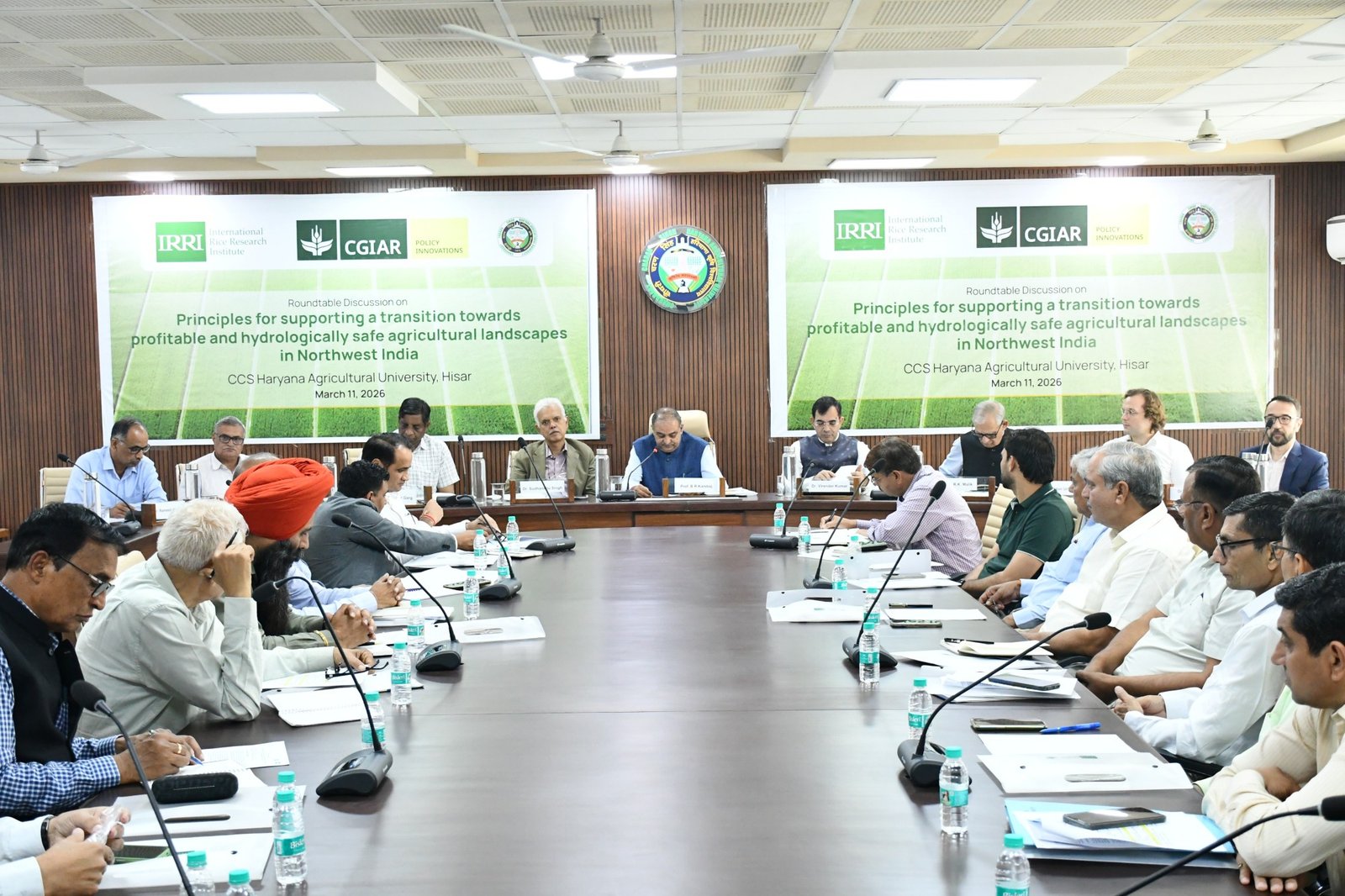
To highlight these emerging issues and identify potential solutions, the roundtable discussion “Principles for supporting a transition towards profitable and hydrologically safe agricultural landscapes in Northwest India” was co-organized by IRRI and Chaudhury Charan Singh Haryana Agricultural University (CCS HAU) at CCS HAU in Hisar, Haryana.
Since the Green Revolution, every major improvement, conflict, and episode of prosperity in the region has been shaped by how water is accessed, managed, and contested. Irrigation transformed these arid and semi-arid landscapes into some of the most productive agricultural zones in the world. Parallelly, these very systems are now pushing the region toward planetary boundaries (Steffen et al., 2015).
The roundtable discussion assembled scientists, policymakers, and practitioners to redesign the agroecosystem. The forum integrated specialized perspectives from IRRI, CCS HAU, the ICAR – Central Soil Salinity Research Institute (CSSRI), Punjab Agricultural University (PAU), the International Water Management Institute (IWMI), and the Haryana Water Resources Authority (HWRA).
The discussions converged around three interconnected themes: (1) robust water resources accounting and irrigation systems, (2) cropping systems agronomy, and (3) sustainable policies. Together, these form the foundation for transitioning toward agricultural systems that are both profitable and hydrologically safe.
A state of emergency for groundwater
With over decades of anthropogenic pressure, Haryana and Punjab are now facing a double-edged water crisis: two-thirds of their agricultural landscape experience severe groundwater depletion, with groundwater table as deep as 50 –70 meters in some areas, while other areas suffer from waterlogging and salinity.
Current assessments reveal that Haryana’s average groundwater extraction has exceeded 136.75 per cent of the annual recharge, with districts such as Kurukshetra with a staggering withdrawal of 225 per cent. This means that the region is withdrawing water at a much faster rate than it can naturally replenish, pushing the landscape toward critical planetary boundaries. Further, 45 per cent of groundwater is currently saline, making it unsuitable for irrigation.
“Not even an inch of groundwater in Haryana is healthy, mostly attributed to poor soil pH, fluoride and nitrate contamination,” said Dr. Satbir S. Kadian from HWRA. Traces of uranium have also been detected in recent years, highlighting the urgency of strict policy enactment to mitigate the implications of the anthropogenic activities on this resource. Dr. Kadian also emphasized that while Haryana being is the first Indian state with fully lined canal systems,many canals remain dry due to seasonal river flows and upstream diversions.
Experts identified the root of the crisis in what they described as “borrowing from the future”—a large-scale irrigation expansion powered by free electricity and intensive rice cultivation. While this enabled food security, it also subsequently triggered declining water tables, rising energy use, and increased greenhouse gas emissions. The discussion delved deeper to illustrate the root causes of major water issues and documented how those insights can help in building the hydrologic blueprint upon which cropping systems can be restructured.
A key takeaway from the discussions was that “piecemeal solutions” like drip irrigation, direct-seeded rice, or canal lining are insufficient. While useful, they cannot independently solve the crisis. Instead, a landscape-scale hydroclimatic approach is needed: one that integrates groundwater, surface water, rainfall, and overall ecosystem dynamics.
Several priorities were emphasized:
Establishing robust aquifer-level water accounting systems.
Developing landscape-scale water mass balance models.
Improving understanding of aquifer structure and geomorphology.
Determining extractable groundwater thresholds based on depth and recharge potential.
Integrating climate variability, and forecasts into water management advisories.
Robust agronomic solutions to transcend marginal water savings
Agronomic practices lie at the core of both problem and solution. The dominance of the cereal system, covering nearly 1.8 million ha in Haryana, has driven this unsustainability. Rice, particularly long-duration varieties such as PUSA 44, is highly water-intensive and contributes significantly to greenhouse gas emissions. Yet, due to market incentives and policy support, farmers continue to rely on it. Meanwhile, crops like cotton have declined due to pest pressures, and traditional crops such as gram and barley have nearly disappeared.
The discussions highlighted the need for cropping system transformation, not just crop substitution. Key recommendations include:
Synchronizing cropping and irrigation systems with short-duration rice varieties like PR 126.
Identifying suitable zones for agroforestry in Haryana for better water interception.
Restricting rice cultivation in Southern Haryana and overall shift towards high-value cropping systems, such as maize-potato-mungbean or soybean-peas-summer mungbean.
Scaling on-farm water harvesting structures, furrow irrigation, and raised bed paddy cultivation.
Data-driven policy packages to implement technological paradigms
To successfully implement advanced hydrological and agronomic technology paradigms in Northwest India, critical structural and policy-related constraints must be addressed first to ensure farming remains profitable.
Currently, the region lacks localized water-use frameworks and guidelines regulating the installation and management of water recharge and harvesting systems. Further, farmers do not receive “water credits” for saving water. Without safe policies that guarantee competitive pricing for crops that use less water, farmers face severe economic risks if they attempt to diversify away from water-intensive crops like rice.
A major hurdle for these policies is the inefficient groundwater accounting system, which relies on a methodology established in the 1970s. This system incorrectly labels any field that receives just one canal irrigation as “canal-irrigated,” even if every other irrigation comes from groundwater wells. This causes systemic errors and massive double-counting that mask actual groundwater dependence.
To overcome barriers and foster agricultural landscape transformation, the roundtable participant recommended several aligned economic incentives and robust policy packages:
Financial safety nets (DBT of at least Rs 37,000 per hectare) to adopt coarse grains, oilseeds, and pulses.
Policy packages should introduce mechanisms for active enforcement on over-extraction alongside water credits for savings.
A data-driven end-to-end policy development framework is required to support the entire spectrum of cropping system transformation with the required empirical evidence.
A dedicated “Centre of Excellence for Water Science” is critical to catalyze this transformation using a consortium of existing hydrological, agricultural, and environmental institutions.
The Path Forward: An Evidence-based Approach
The pathway forward must be iterative and evidence-based, beginning with hydroclimatic scenario assessments, followed by agronomic optimization, and culminating in adaptive policy design. Moreover, trade-off analyses, field-scale experimentation, and continuous farmer engagement are essential to ensure that proposed solutions are adaptable at landscape scale (Deb et al. 2025). In this context, institutional coordination and data integration across states and sectors become indispensable.
Northwest India now stands at a pivotal transition point. The next agricultural transformation must not aim to maximize production alone, but to optimize environmental resource use while sustaining farm livelihoods. This transition requires coordinated investments in science, infrastructure, and policy, alongside a shift in mindset from extraction to stewardship of water resources. If approached holistically, this transition presents an opportunity to build a resilient, climate-adaptive, and economically sustainable agricultural system for northwest India.