Monday, 15 June 2026

Climate-smart farming, digital innovation and farmer welfare drive BRICS agriculture consensus.
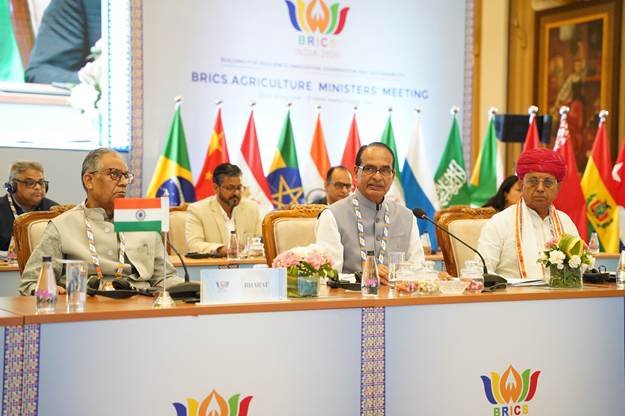
The BRICS Agriculture Ministers’ Meeting held in Indore, concluded on Friday with the unanimous adoption of the ‘Indore Declaration’, marking a significant milestone in global agricultural cooperation. The declaration outlines several landmark decisions aimed at strengthening food security, farmer welfare, climate-resilient agriculture, agricultural trade and digital agriculture. Addressing a press conference, Union Minister for Agriculture & Farmers Welfare and Rural Development Shivraj Singh Chouhan said that at a time of global crises and uncertainties, the BRICS meeting had sent a strong message of hope, trust and collective responsibility to the world.
Scale, Strength and Significance of the meeting
Interacting with the media in the presence of Union Ministers Ramnath Thakur and Bhagirath Choudhary, along with senior officials, Chouhan said that both the Senior Officials’ Meeting and the Ministerial Meeting of the BRICS Agriculture Working Group concluded successfully. He informed that nearly 100 delegates participated in the meetings, including around 60 foreign representatives from BRICS member and partner countries, reflecting the depth of engagement and seriousness with which BRICS nations are addressing issues related to agriculture and food security. Chouhan noted that BRICS countries represent nearly half of the world’s population, possess around 42 per cent of global agricultural land, and contribute approximately 42 per cent of global foodgrain production. Consequently, the collective voice of BRICS has emerged as a powerful force on the global stage.
He also expressed pride that India currently holds the BRICS Presidency under the leadership of Prime Minister Narendra Modi and that both the official-level and ministerial-level agriculture meetings were organised in Indore in this context.
Four major priorities discussed
The Union Minister said extensive deliberations were held around four key priorities:
Food security and nutritional security for BRICS countries and the world. Promotion of agricultural trade and cooperation among BRICS nations. Regenerative, climate-resilient and sustainable farming practices in response to climate change. Strengthening innovation, technology and partnerships in food systems and agriculture.
He emphasised that ensuring abundant food availability, improving nutritional outcomes and securing the livelihoods of farmers who feed the world remained central to the discussions. Chouhan said a dedicated session was organised for small and marginal farmers, referred to as family farmers in several countries. Discussions focused on their challenges, access to agricultural inputs, credit availability, remunerative prices and market linkages.
Indore Declaration: A Farmer-Centric Global Commitment
Shivraj Singh Chouhan said that following extensive consultations, the joint declaration was unanimously adopted and would henceforth be known as the “Indore Declaration”. He stated that the declaration places farmers at its core and records the shared commitment of BRICS countries to advance food security, nutrition, livelihoods, agricultural trade, innovation, investment, climate-resilient farming and sustainable agricultural development. “This document is a symbol of the collective will, shared responsibility and commitment of BRICS nations to build a safer, more prosperous and sustainable future through agriculture,” he said. He added that member countries had agreed to work collectively and continuously to ensure that the initiatives outlined in the declaration are implemented effectively and deliver tangible benefits to farmers, rural communities and food systems.