Friday, 10 July 2026

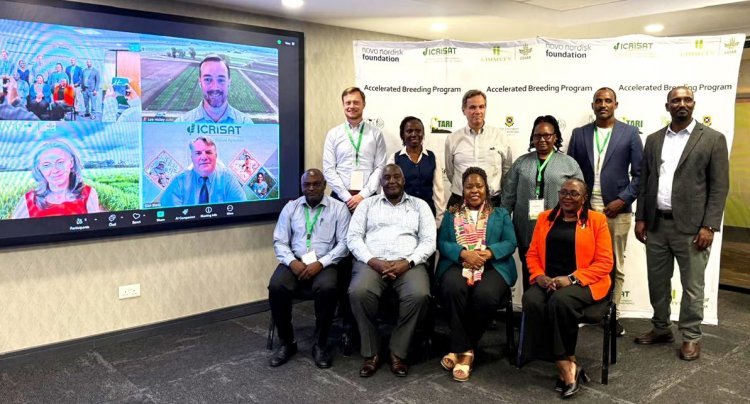
Backed by the Novo Nordisk Foundation, the five-year programme seeks to accelerate the development of climate-resilient sorghum and groundnut varieties across Africa and India through predictive breeding, genomic science and advanced data integration.
The International Crops Research Institute for the Semi-Arid Tropics and CIMMYT have unveiled an ambitious multi-country scientific initiative aimed at transforming dryland agriculture through next-generation crop breeding technologies, as climate volatility intensifies pressure on food systems across Africa and South Asia. Supported by the Novo Nordisk Foundation, the five-year programme seeks to dramatically compress the time required to develop climate-resilient and market-responsive crop varieties for some of the world’s most vulnerable farming regions.
The initiative, titled Applying Modern Tools to Enhance Precision and Speed of Dryland Crops Breeding, will initially focus on sorghum and groundnut as proof-of-concept crops while establishing a scalable framework for broader dryland crop improvement across India and Eastern Africa. The programme is designed to integrate artificial intelligence-driven predictive breeding, genomic selection, speed breeding technologies and advanced data integration systems to modernise conventional breeding pipelines and accelerate genetic gains.
The collaboration brings together the scientific capabilities of CGIAR institutions, national agricultural research systems in Kenya, Ethiopia, Tanzania and India, alongside the University of Queensland, globally recognised for its expertise in predictive breeding science. The initiative represents a strategic convergence of international research infrastructure, genomic resources, digital agriculture capabilities and local agronomic expertise to strengthen resilience in dryland farming systems increasingly exposed to climatic stress.
The programme aims to reduce breeding cycle timelines by at least two years while substantially increasing the rate of genetic improvement in target crops. Researchers expect the integration of predictive analytics and genomic technologies to enable faster delivery of drought-tolerant, heat-resilient and disease-resistant crop varieties capable of sustaining productivity under increasingly erratic environmental conditions.
Dryland agriculture currently supports more than two billion people globally, yet remains disproportionately vulnerable to climate-induced disruptions including prolonged droughts, declining soil fertility, heat stress and irregular rainfall patterns. The initiative seeks to address these structural vulnerabilities by repositioning Africa and South Asia at the forefront of predictive breeding innovation and climate-resilient crop development.
The project additionally reflects the accelerating importance of collaborative scientific ecosystems in tackling interconnected food security and climate challenges. Participating institutions indicated that the programme has been structured not merely as a breeding intervention, but as a long-term platform for institutional knowledge exchange, shared research infrastructure and capacity building across national agricultural systems.
Beyond productivity enhancement, the initiative is expected to contribute to broader food and nutrition security objectives while generating new opportunities for smallholder farmers, women and youth engaged in climate-sensitive agricultural economies. By integrating frontier science with locally grounded agricultural knowledge, the programme seeks to establish a new benchmark for scalable, data-driven crop improvement in some of the world’s most environmentally fragile farming landscapes.