Tuesday, 23 June 2026

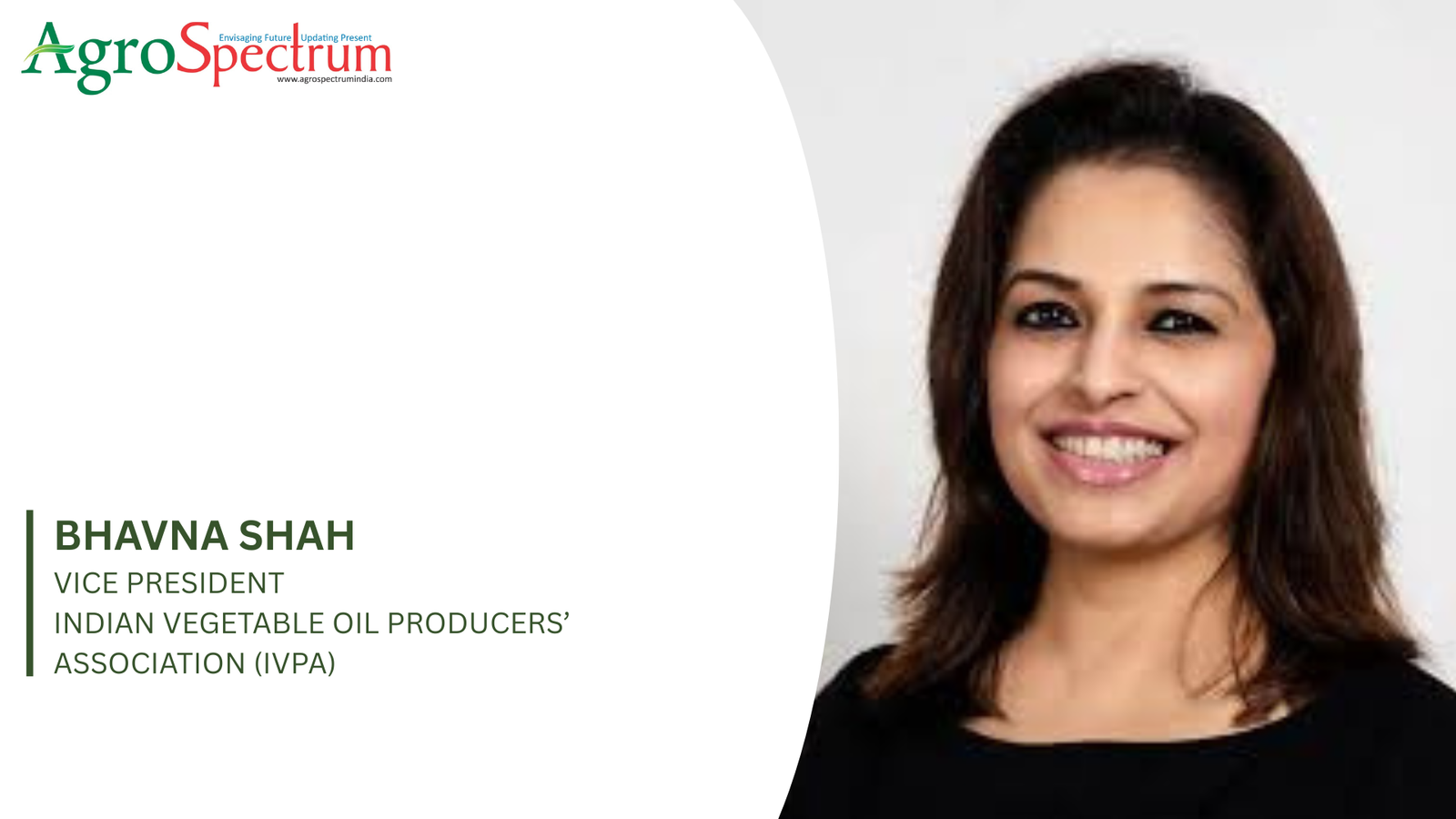
Bhavna Shah of IVPA discusses India’s growing role in global edible oil price discovery, the risks of rising import dependence, and why productivity-led reforms are critical for long-term resilience
In this exclusive interview, Bhavna Shah, Vice President of the Indian Vegetable Oil Producers’ Association, discusses how India’s edible oil sector is navigating a complex intersection of economic growth, climate risks, geopolitical disruptions, and global biofuel policies. She highlights that while India’s structural demand for edible oils remains strong, the country must focus on improving domestic oilseed productivity, strengthening supply-chain resilience, and ensuring policy stability to reduce long-term import vulnerability. The conversation also underscores India’s evolving role from being merely the world’s largest edible oil importer to becoming a major policy-sensitive market influencing global trade flows, pricing dynamics, and supply balances.
India’s GDP growth is projected at 7.4 percent in FY26, with services leading the surge. How do you see this macroeconomic resilience translating into demand dynamics for edible oils, particularly in urban versus rural consumption patterns?
India’s macro resilience is supporting a stable but more mature edible oil demand cycle. Unlike the post-COVID rebound phase, we are now seeing normalized consumption growth, likely below 2 percent annually on a per capita basis.
Urban demand remains relatively resilient, driven by rising disposable incomes, organised retail, QSR expansion, packaged food growth, and premiumisation trends. Consumers are increasingly diversifying across sunflower, rice bran and health-positioned packaged oils, particularly in metro and Tier-1 markets.
Rural demand, however, remains more sensitive to food inflation, monsoon outcomes, and real wage growth. Weak monsoons or elevated crude-linked inflation can compress discretionary consumption in rural India, impacting overall edible oil offtake.
What is critical in India is the scale effect. Even a 1 kg per capita increase in annual consumption translates into roughly 1.4 million tons of additional demand. So even moderate GDP-led consumption growth creates disproportionate pressure on supply balances and import requirements.
Therefore, the challenge is not demand creation — India already has structural demand strength. The challenge is ensuring supply-side elasticity keeps pace with income-driven consumption growth.
You’ve described 2026/27 as a convergence year where climate stress, geopolitical shocks, and biofuel mandates collide. What specific risk transmission channels worry you most for India’s edible oil supply chain?
The biggest concern is the increasing interconnectedness of risks across commodities, energy, logistics, and agriculture. We are no longer dealing with isolated disruptions; we are dealing with cascading transmission effects.
The first major channel is energy-linked inflation. Crude oil volatility directly impacts freight, solvent extraction and other refining costs, packaging materials, and edible oil prices. Geopolitical tensions in West Asia or the Black Sea immediately increase costs.
Second is climate risk. Weak monsoons affect domestic oilseed output, rural incomes, reservoir levels, and input usage simultaneously. This creates both supply-side and demand-side stress coupled with disruption in supply of fertilizers.
Government of India is taking many proactive steps to kee the costs under control and ensure supplies.
Third is global biofuel diversion. Indonesia, Malaysia, the US, and ASEAN biofuel mandates are structurally tightening vegetable oil availability. When biodiesel economics become attractive, edible oils increasingly compete with fuel demand, reducing exportable surpluses.
Fourth is supply chain fragility. Delays in Argentina soybean oil shipments, port disruptions, currency volatility, or insurance cost spikes can quickly destabilise import planning.
Finally, inflation transmission itself is becoming more complex. India can still manage short-term supply shocks through tactical imports and duty calibration, but repeated external disruptions increase the risk of sticky food inflation feeding into broader CPI expectations.
With domestic availability covering only 40–45 percent of consumption and import dependence locked at 55–60 percent, what policy levers can realistically narrow this structural gap in the medium term?
There is no single silver bullet. India’s edible oil challenge is structural and requires a multi-layered strategy.
First, productivity enhancement is more important than acreage expansion alone. India’s oilseed yields remain significantly below global benchmarks. Improving seed technology, irrigation efficiency, extension services, and mechanisation can deliver more sustainable gains.
Second, policy consistency is critical. Frequent duty changes create uncertainty across the value chain. Long-term investment in oilseeds requires predictable pricing and trade policies coupled with a robust domestic exchanges for management of risk.
Third, the National Mission on Edible Oils must move beyond incentives toward ecosystem development — including nursery infrastructure, processing capacity, logistics, and farmer assurance mechanisms.
Fourth, crop economics must improve. Farmers continue to favour maize, cotton, or other remunerative crops over oilseeds. Unless oilseed profitability becomes competitive on a risk-adjusted basis, acreage shifts will remain limited.
Fifth, India should strategically diversify import origins and reduce concentration risk while simultaneously strengthening domestic crushing and storage infrastructure.
In reality, import dependence may moderate gradually, but complete self-sufficiency is unlikely in the foreseeable future given India’s demographic scale and land constraints.
The Oil Palm Mission aims to raise palm oil availability to 1.2 MMT by 2030. Given the slow progress in acreage expansion, especially in the North-East, do you believe this target is achievable, or is it more aspirational?
The target remains ambitious.
Oil palm is fundamentally a long-gestation crop with a 4–5 year maturity cycle. Therefore, policy intent today translates into output gains only several years later as seen in Malaysia, Indonesia,Thailand etc.
The North-East has agro-climatic potential, but execution challenges remain significant — including fragmented landholdings, logistics limitations, processing infrastructure gaps, and farmer hesitancy around long gestation periods.
Additionally, oil palm economics depend heavily on fresh fruit bunch evacuation efficiency and mill proximity. Without strong downstream infrastructure, plantation expansion alone will not deliver commercially viable outcomes.
That said, India has learned from Indonesia and Malaysia that palm offers the highest oil yield per hectare among major oil crops. Strategically, it remains India’s most viable pathway to improving edible oil self-reliance. So, I would describe the 1.2 MMT target as challenging but directionally important. Even partial success materially improves India’s import vulnerability over time.
Imports remain range-bound at 15–17 MMT, but the mix is shifting — soybean oil surged to 5 MMT in FY26 while palm oil declined. How does this evolving composition alter India’s bargaining power in global markets?
India’s bargaining power is evolving from volume dominance to strategic balancing influence.
Historically, India was primarily a price-sensitive palm oil buyer. But as import diversification increases — including higher soybean and sunflower oil participation — India gains greater sourcing flexibility and negotiating leverage and all this drivers by consumer preferences.
At the same time, the global market also becomes more aware of India’s sensitivity to inflation and policy action. Even minor duty changes or buying slowdowns in India can significantly influence global vegetable oil sentiment and price discovery.
However, diversification also comes with trade-offs. Soybean oil is more exposed to weather risks in South America and biofuel policies in the Americas. Sunflower oil remains geopolitically vulnerable due to Black Sea disruptions.
Palm oil still retains a structural affordability advantage for India, especially for HORECA segment and foodservice applications. Therefore, diversification improves resilience but does not eliminate dependence. India is increasingly acting not just as the world’s largest buyer, but as the balancing market that absorbs surplus flows and stabilises global trade imbalances.
MSP revisions and duty adjustments have been described as incremental and tactical. What structural reforms would you advocate to move beyond short-term inflation management toward long-term resilience?
India now needs structural competitiveness, not just tactical intervention.
The first reform is a national oilseed productivity mission focused on yield improvement through better genetics, precision farming, and climate-resilient agriculture.
Second, India must strengthen farm-to-processing integration. Fragmentation between farmers, crushers, refiners, and downstream users reduces efficiency across the value chain.
Third, investment in storage and logistics infrastructure is essential. Better warehousing and buffer mechanisms can reduce volatility during supply shocks.
Fourth, policy coordination across food, feed, and fuel sectors has become increasingly important. Corn, DDGS, ethanol, and oilseeds are now economically interconnected. Silo-based policymaking is no longer effective.
Fifth, India should encourage private sector participation in research, contract farming frameworks, and value-added processing.
Most importantly, reforms must balance farmer remuneration with consumer affordability. India’s edible oil sector sits at the intersection of food security, inflation management, and trade policy — making it one of the most strategically sensitive agri-commodity sectors globally.
India is moving from being a pure demand anchor to a policy-driven market shaper. How do you see this transition influencing global price discovery and trade flows in the next five years?
India’s influence on global edible oil markets will deepen significantly over the next five years.
Traditionally, India was viewed largely as a passive importer responding to global prices. That is changing. Today, India’s import duties, stock positions, procurement behaviour, and policy signals increasingly influence global trade flows and futures sentiment.
As global vegetable oil balances tighten due to biofuel mandates and climate volatility, India’s role as the largest structural demand centre becomes even more critical.
We are also seeing the emergence of more supply-driven trade flows. China’s soybean oil entering India after decades is an example of how global exporters are recalibrating around Indian demand dynamics.
Going forward, India will likely play three simultaneous roles:
* A major demand anchor,
* A volatility transmission centre,
* A policy-sensitive price discovery market.
In many ways, India is becoming the balancing mechanism of the global vegetable oil economy.
Biofuel mandates are structurally tightening global palm oil supply. How should India balance its energy security ambitions with the unintended consequences for edible oil inflation?
This is one of the most important policy balancing acts ahead.
Globally, biofuel mandates are no longer cyclical — they are structural. Indonesia, Malaysia, the US, and ASEAN economies are increasingly diverting vegetable oils toward energy applications. India also has legitimate energy security goals, particularly around ethanol blending and renewable fuels. However, India’s edible oil deficit creates a different economic reality compared to producer nations.
Therefore, India must adopt a calibrated approach. Food security and inflation stability cannot be compromised in pursuit of aggressive biofuel targets. The focus should be on diversified feedstocks — including used cooking oil, agri-residue, second-generation biofuels, and non-food energy pathways — rather than excessive dependence on edible oils.
Equally important is ecosystem alignment. India’s earlier biodiesel experience showed that policy ambition without supply chain viability can leave capacity stranded. The ideal approach is balanced sequencing — scaling energy transition goals while ensuring edible oil affordability, farmer viability, and supply security remain protected.
— Suchetana Choudhury (suchetana.choudhuri@agrospectrumindia.com)