Wednesday, 3 June 2026

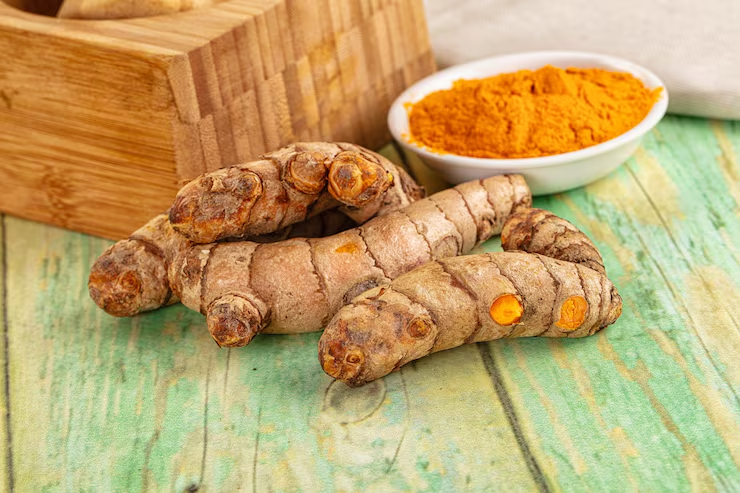
Kerala commands premium pricing above Rs 18,000 while Erode emerges as volume epicenter with over 570 Metric Tonnes
India’s turmeric markets witnessed a pronounced divergence between price realization and arrival volumes during April 12–13, 2026, as southern states continued to dominate trade dynamics. While Kerala markets commanded premium prices for high-grade produce, Tamil Nadu—particularly Erode—reinforced its position as the country’s largest turmeric trading hub by volume.
According to the latest Daily Price Arrival Report, turmeric prices ranged from approximately Rs 11,450 to Rs 18,000 per quintal across key mandis, reflecting variations in quality grades, regional demand, and supply concentration.
Kerala’s Idukki district recorded the highest price realization in the country. At Thodupuzha APMC, Grade Range-1 dry turmeric achieved a modal price of Rs 18,000 per quintal, with prices ranging between Rs 17,800 and Rs 18,000. Another lot of turmeric in the “Other” category was traded at a slightly lower modal price of Rs 15,900 per quintal. However, arrivals remained limited at just 0.20 metric tonnes per transaction, underscoring a tight supply environment for premium-grade produce.
In contrast, Tamil Nadu’s markets demonstrated scale-driven trade momentum. Erode APMC handled the largest arrivals, with a substantial 570.53 metric tonnes traded on April 13. Despite the high volume, modal prices remained competitive at Rs 12,685 per quintal, within a broad price band of Rs 10,518 to Rs 14,852. This highlights Erode’s role as a price discovery center where bulk trading and diverse quality supplies influence overall market benchmarks.
Perundurai APMC, also in Erode district, reported arrivals of 217.09 metric tonnes, with a higher modal price of Rs 13,764 per quintal. The relatively stronger pricing compared to Erode APMC suggests better quality consistency or stronger localized demand.
Other Tamil Nadu markets presented mixed trends. Dharampuri APMC recorded a modal price of Rs 12,500 per quintal with arrivals of 37.12 metric tonnes, while Krishnagiri APMC reported a lower modal price of Rs 11,755 per quintal with minimal arrivals of 0.73 metric tonnes. These variations reflect localized supply-demand imbalances and differences in turmeric quality.
Northern markets, particularly in Uttar Pradesh, exhibited stable but relatively moderate pricing. Kanpur (Grain) APMC recorded a modal price of Rs 11,450.95 per quintal with arrivals of 21.10 metric tonnes, while Lucknow APMC reported a higher modal price of Rs 13,845.57 per quintal supported by arrivals of 34.70 metric tonnes. The FAQ-grade classification in these markets indicates standardized quality suitable for broader consumption rather than premium or export segments.
The data reveals a clear structural pattern within India’s turmeric trade. High-value, low-volume markets such as Kerala are driven by premium quality and limited supply, whereas high-volume centers like Erode shape national price trends through scale and liquidity.
A notable trend is the inverse relationship between arrivals and prices across regions. Markets with constrained supply, such as Thodupuzha, consistently report higher prices, while bulk markets like Erode maintain price stability despite large inflows. This reflects a balanced market ecosystem where both premium and bulk segments coexist with distinct demand drivers.
The wide price band observed across markets—from Rs 10,000 to Rs 18,000 per quintal—also underscores the importance of grade differentiation. Grade Range-1 and dry turmeric varieties continue to command significant premiums, while FAQ and local varieties are priced more competitively to cater to domestic consumption.
From a strategic standpoint, the sustained dominance of Tamil Nadu in terms of arrivals reinforces its critical role in India’s turmeric supply chain. Meanwhile, Kerala’s premium positioning highlights opportunities for value-added and export-oriented segments.
As turmeric continues to be a key commodity in both domestic consumption and global spice trade, these pricing and arrival trends are expected to influence procurement strategies, farmer realization, and export competitiveness in the coming months.