Tuesday, 19 May 2026

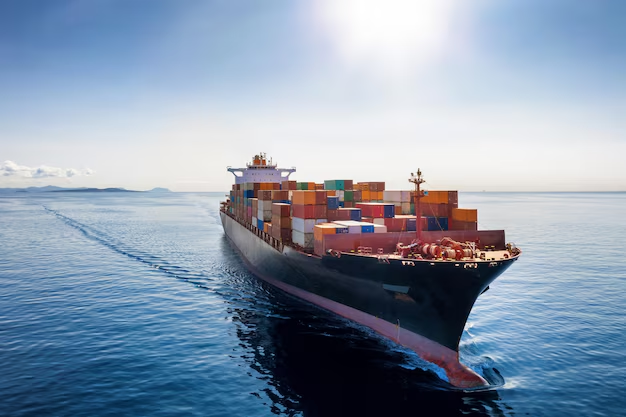
This exemption transforms JNPA into a temporary haven for cargo caught in the ebb and flow of international uncertainty
In a decisive and conciliatory move aimed at steadying the rhythms of India’s external trade, the Jawaharlal Nehru Port Authority (JNPA) has announced a sweeping waiver of storage (dwell time) charges and reefer plug-in fees for export containers destined for the Middle East—cargo that has found itself unexpectedly marooned amid continuing geopolitical turbulence in the region.
The announcement, formalised through a trade notice issued under the guidance of the Ministry of Ports, Shipping and Waterways, reflects a calibrated intervention designed to soften the financial strain on India’s export-import ecosystem at a time when global supply chains are under pronounced stress.
A Policy Cushion for Stranded Trade
Anchored within the provisions of the Major Port Authorities Act, 2021 and the governing tariff framework for major ports, the relief package seeks to provide immediate breathing space to exporters, freight forwarders, and logistics operators navigating disrupted schedules and congested flows.
Under the revised facilitation measures, containers bound for Middle Eastern destinations—currently delayed at JNPA terminals—will be permitted extended residence within container yards without accruing the usual burden of ground rent or refrigerated plug-in charges. This exemption effectively transforms the port into a temporary haven for cargo caught in the ebb and flow of international uncertainty.
Temporary Anchorage, Continuous Commerce
In parallel, JNPA is working in close coordination with customs authorities to enable the accommodation of laden containers originating from other Indian ports, designating them as temporary transshipment cargo within its terminal infrastructure. This strategic accommodation is intended to prevent systemic bottlenecks and ensure that trade flows, though strained, remain unbroken.
To further absorb the surge in grounded cargo, additional yard capacity is being extended to terminal operators, reinforcing the port’s operational elasticity during this period of regional instability.
Stability Amid Uncertainty
JNPA has emphasised that these measures are not merely administrative adjustments, but part of a broader commitment to sustaining trade continuity and insulating stakeholders from cascading financial pressures triggered by external shocks.
By easing costs and expanding storage flexibility, the port authority seeks to preserve the integrity of India’s export channels while global conditions remain fluid and unpredictable.
Industry Response
The initiative has been met with appreciation across the logistics and export community, with stakeholders acknowledging the timeliness of the intervention. Industry voices have noted that such responsive policy measures act as vital stabilisers—tempering cost escalation, reducing operational friction, and restoring a measure of predictability to an otherwise volatile trade environment.
In a moment when global commerce often bends under the weight of geopolitics, JNPA’s latest move stands as a quiet assertion: that ports are not merely gateways of goods, but custodians of continuity.