Tuesday, 19 May 2026

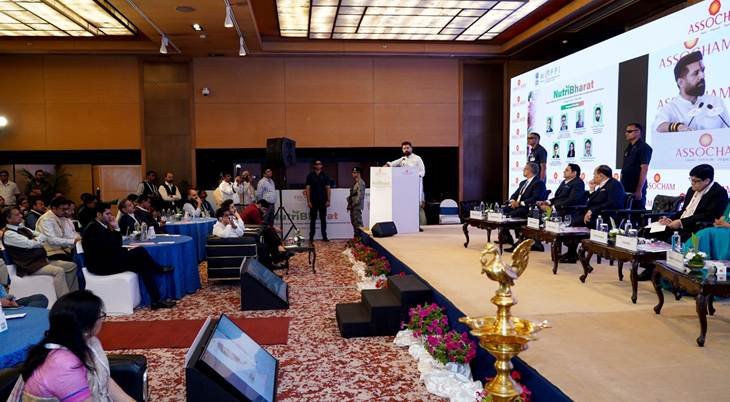
Union Minister of Food Processing Industries, Chirag Paswan emphasized the need for a roadmap in the food processing and nutraceutical sector in the country, saying that the sector must align itself with the vision of becoming a developed nation by 2047.
While addressing ASSOCHAM’s “NutriBharat 2026: National Conference on the Role of Nutraceuticals and Functional Foods in Strengthening Nutrition Security,” the minister said the sector must set clear milestones for the next year, five years, and ten years while working collaboratively with policymakers and regulators to unlock its full potential.
“India has successfully moved from food scarcity to food security. The next frontier is “nutrition security, ensuring that our future generations are healthy and free from malnutrition,” Paswan said. He emphasized that the food processing industry has a crucial role to play in delivering safe, nutritious, and high-quality food products to consumers.
A joint knowledge paper titled ‘NutriBharat@2047 – India’s Nutritional Transition through Nutraceuticals and Functional Foods’, released by EY and ASSOCHAM, underscores the urgent need for India to transition from a food‑security framework to a “nutrition for all” approach.
The report calls for modernising India’s regulatory ecosystem through structured health‑claims governance, tiered evidence standards, AI‑enabled validation systems and a national quality seal to enhance scientific credibility and global trust. It emphasises agriculture as the backbone of India’s future nutraceutical leadership, advocating for integrated farm‑to‑formulation value chains built on GAP‑certified FPOs, biofortified crops, botanicals and plant proteins.
Sharing his views on the knowledge paper, Amit Vatsyayan, Partner and Social Sector Leader, EY India, said, “An industry‑led, agriculture‑powered nutrition ecosystem can deliver measurable public health outcomes at scale. By integrating India’s AYUSH heritage with clinical evidence and standards‑driven manufacturing, the sector can build a verifiable farm‑to‑formulation value chain linking GAP‑aligned FPOs, biofortified millets and pulses, botanicals and plant proteins through digital traceability and transparent testing. With strong claims governance and export certification, this approach can convert India’s biodiversity into globally trusted nutrition products. Sustained industry investment in science, farmer partnerships and consumer awareness would be critical to expanding access, enhancing rural incomes and advancing preventive, outcomes‑oriented nutrition, positioning India as a leading global market player.”
Further, highlighting the importance of maintaining global standards, the minister urged industry players to ensure that quality is never compromised, noting that even a single rejected consignment at an international port can damage India’s reputation built over decades. He also stressed the need for innovation, responsible manufacturing practices, and stronger collaboration between industry, regulators, and research institutions.
Paswan noted that India has the potential to emerge as a “global food basket,” supported by its strong agricultural base, growing food processing capacity, and expanding global trade partnerships. However, he said this vision can only be realised through collective responsibility and a strong commitment to quality and consumer trust.
Providing a global perspective, Takayuki Hagiwara, FAO Representative in India, observed that the global conversation has shifted from food security to nutrition security, and nutraceuticals are becoming an important tool to bridge nutritional gaps in modern diets. He also highlighted the need to build reliable, innovative, consumer-oriented, and hygienic agri-food systems to support healthier populations.
Speaking on regulatory developments, Dr. Alka Rao, Advisor (Science & Standards & Regulations), FSSAI, emphasised the role of science-based regulations and stakeholder engagement in strengthening India’s food ecosystem. She noted that the regulator has undertaken extensive consultations with industry and is actively working to develop frameworks for emerging areas such as nutraceuticals, probiotics, and functional foods while also aligning with global standards through platforms such as the Codex Alimentarius Commission.
The conference brought together policymakers, regulators, industry leaders, researchers and global organisations to discuss innovation, regulatory frameworks, research collaboration and global opportunities for India’s nutraceutical and functional food sector.