Wednesday, 20 May 2026

Industry leaders call for inclusive agri-tech design, capacity building, and service-based technology models to empower women farmers and entrepreneurs
The role of women in agriculture is undergoing a critical reassessment as policymakers, entrepreneurs, and social impact leaders increasingly recognise that inclusive growth in the farm sector cannot be achieved without integrating women into decision-making, technology adoption, and agribusiness leadership. At AgroSpectrum Technovate 2026, a panel of experts highlighted the structural barriers that continue to limit women’s participation in agricultural innovation while outlining pathways to transform women farmers into key drivers of India’s agri-tech and rural economy.
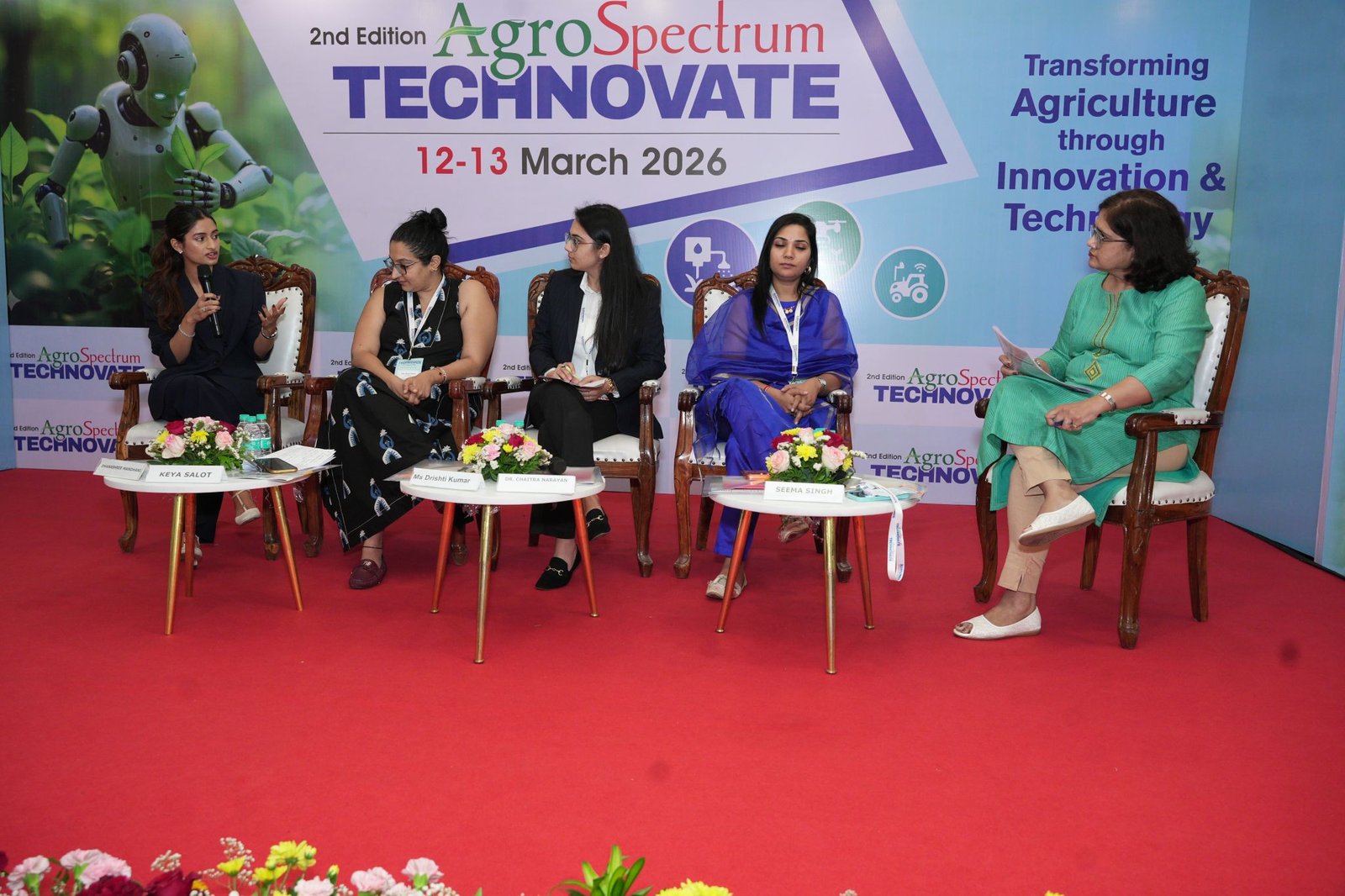
The discussion featured Drishti Kumar, Agritech Specialist, World Economic Forum; Keya Salot, Founder, Farm2Fam ; Dr. Chaitra Narayan, Founder & Director, Kodagu Agritec Pvt Ltd; Dhanashree Mandhani, Founder & CEO, Salam Kisan and Co-Founder, PRYM Aerospace AI; and Seema Singh, Marketing and Communication Strategist & Social Impact Leader. The panel examined how policy reforms, technology-driven service models, and targeted capacity building could unlock the untapped potential of women in agriculture.
Opening the discussion, Drishti Kumar emphasised that the design of agricultural technologies and programs must consciously consider both men and women farmers. She noted that while tools and systems are often designed to serve all farmers, in practice they frequently overlook the realities faced by women who perform a large share of agricultural labour. According to Drishti, women farmers tend to be highly responsive to capacity-building initiatives when provided with the right support structures. Training, community awareness, and skill development programs can significantly accelerate technology adoption among women.
She pointed to initiatives such as the Mahashakti Drone Project, which aims to enable women’s participation in emerging agricultural technologies. By building a supportive ecosystem around technology adoption, such initiatives not only empower women but also expand the reach of digital agriculture tools across rural communities. Drishti argued that strengthening community engagement and training programs is essential to ensure that women farmers become active participants rather than passive beneficiaries of agricultural innovation.
Dhanashree Mandhani highlighted the vast untapped business and innovation potential that lies in integrating women into the agri-tech ecosystem. She noted that many opportunities in agriculture emerge directly from unresolved challenges, and women represent one of the largest underleveraged segments of the agricultural workforce. Despite their significant contribution to farming activities, women often remain informal stakeholders within agricultural systems.
Dhanashree referenced findings from the Food and Agriculture Organization which suggest that if women farmers had the same access to resources, inputs, and services as men, agricultural productivity could increase by as much as 43 percent. However, she pointed out that structural barriers—particularly the lack of land ownership—continue to limit women’s ability to invest in farming technologies or access institutional support.
To overcome these constraints, Dhanashree advocated the development of service-oriented technology models, where women can participate as drone operators, agricultural extension workers, and technology service providers. Training women to operate and manage agricultural technologies could open new livelihood opportunities while simultaneously expanding the reach of precision agriculture solutions.
Building on this perspective, Keya Salot argued that integrating women into agriculture should be viewed not only as a social imperative but also as an economic necessity. According to her, women must be actively involved in financial and operational decision-making within farm households and agricultural enterprises. When women are empowered to participate in decisions regarding investments, cropping strategies, and market engagement, the overall resilience and productivity of farming systems improve.
Keya noted that one of the major challenges women face is the inability to visualise the scale of opportunities available within agricultural value chains. Limited exposure to markets, technologies, and entrepreneurship opportunities often restricts women’s aspirations. Expanding access to markets, she argued, is therefore critical to enabling women farmers to move beyond subsistence roles and become active participants in agricultural value creation.
She also highlighted the need for stronger digital infrastructure to support women’s market integration. Currently, the absence of blockchain-enabled traceability systems and data-backed supply chain platforms makes it difficult for small-scale producers, particularly women, to establish direct and transparent market linkages.
Dr. Chaitra Narayan brought attention to the gap between statistical representation and ground realities faced by women in agriculture. While official figures suggest that women constitute around 43 percent of the agricultural workforce, the lived experience of women farmers often reflects limited recognition, inadequate institutional support, and restricted access to resources.
Dr. Narayan emphasised that meaningful change will require policy reforms at the administrative level, particularly in areas such as inheritance laws and land ownership patterns. Land ownership remains a central issue because without legal rights to land, women are often excluded from credit systems, government subsidies, and technology investments. Strengthening women’s property rights, she argued, is fundamental to improving their economic agency within agriculture.
She also observed that many women farmers lack awareness of how emerging technologies can improve productivity and profitability. Addressing this knowledge gap requires targeted training programs that demonstrate the practical benefits of modern farming technologies in accessible and relatable ways.
Adding another dimension to the discussion, Seema Singh highlighted the structural inequalities that continue to shape women’s roles in agriculture. According to her, approximately 55 percent of women working in agriculture are engaged primarily as labourers, often performing physically demanding tasks with limited recognition or economic security.
Seema argued that many agricultural technologies are conceptualised and developed through a predominantly male perspective, which affects how they are designed, marketed, and implemented. As a result, agri-tech solutions are often framed around male farmers even though women constitute a substantial portion of the agricultural workforce.
For technology adoption to become truly inclusive, Seema stressed that women must be involved in the development process itself. When women farmers are consulted and engaged during the design and testing phases of agricultural technologies, solutions are more likely to reflect real-world needs and constraints.
She also emphasised the importance of community-based adoption models, where women learn and adopt technologies collectively rather than individually. Training initiatives focused on emerging opportunities such as carbon credit systems are already being implemented through collaborations with organisations such as Mahyco and UPL, creating new avenues for women farmers to participate in climate-smart agriculture.
The panel discussions at AgroSpectrum Technovate 2026 underscored that the future of agriculture cannot be fully realised without addressing the systemic barriers that women continue to face. While women contribute significantly to farming operations, their participation in decision-making, technology adoption, and market access remains limited.
Experts agreed that unlocking the full potential of women in agriculture will require a multi-dimensional strategy that includes policy reforms, improved access to land and financial resources, targeted capacity building, and the development of inclusive technology ecosystems. By positioning women not only as farmers but also as entrepreneurs, innovators, and technology operators, India can accelerate both agricultural productivity and rural economic growth.
As the sector moves toward a more digital and technology-driven future, the integration of women into the agricultural innovation ecosystem will be critical. AgroSpectrum Technovate 2026 reinforced a clear message: empowering women farmers is not merely a question of equity—it is a strategic necessity for building a resilient, productive, and sustainable agricultural economy.
— Suchetana Choudhury (suchetana.choudhuri@agrospectrumindia.com)