Thursday, 25 June 2026

Rice and climate-resilient crops gain ground while cotton and pulses lose acreage
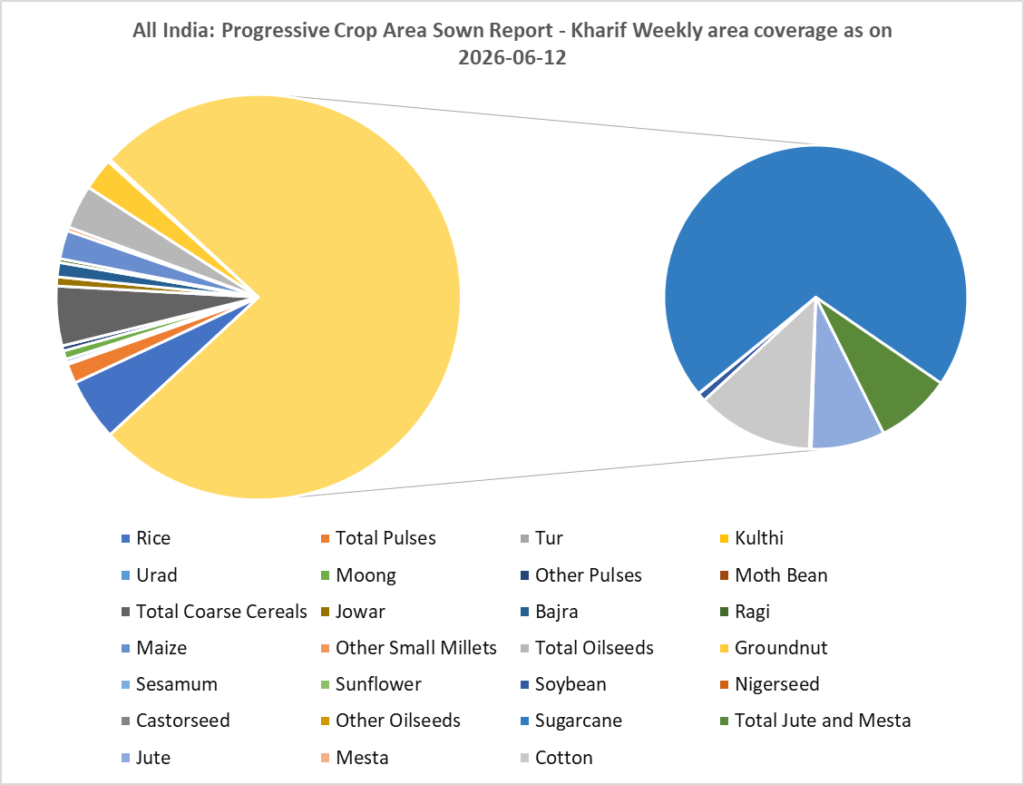
India’s Kharif 2026-27 sowing season has opened with a mixed acreage pattern, reflecting divergent farmer preferences, evolving monsoon dynamics and shifting crop economics. Data released by the Department of Agriculture and Farmers Welfare (DA&FW) shows that total area sown across major Kharif crops stood at 84.60 lakh hectares, compared with 88.04 lakh hectares during the corresponding period last year, representing a decline of 3.43 lakh hectares, or 3.9 per cent.
The early-season sowing trends reveal a significant redistribution of acreage among crops rather than a broad-based contraction in agricultural activity. While rice, bajra and groundnut have witnessed strong expansion, substantial declines in cotton, pulses and soybean acreage have offset these gains, resulting in an overall reduction in national coverage.
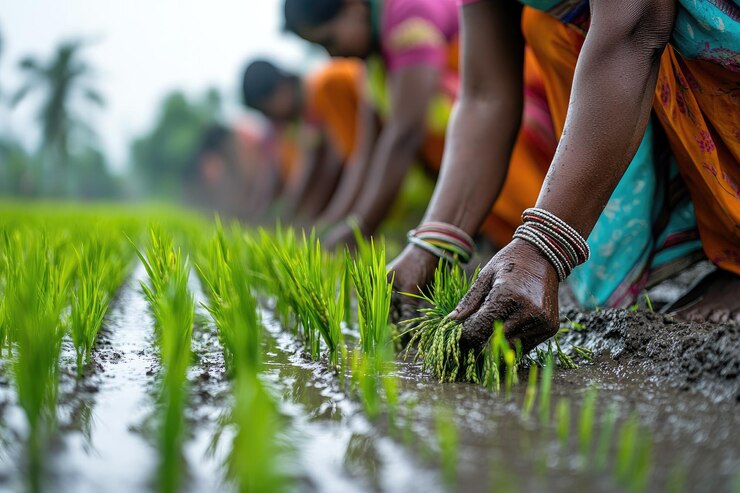
Rice has emerged as the strongest performer in the opening phase of the Kharif season. Area under rice cultivation has reached 4.98 lakh hectares, compared with 3.88 lakh hectares during the same period last year. The increase of 1.09 lakh hectares, equivalent to 28.21 per cent, represents one of the most significant gains among major crops. The expansion suggests that farmers remain confident about paddy cultivation amid expectations of adequate monsoon rainfall and continued policy support through procurement mechanisms. Although current acreage remains a small fraction of the crop’s normal area of 412 lakh hectares, the early momentum points toward a positive start for the country’s most important foodgrain crop.
The pulse sector presents a markedly different picture. Total pulse acreage has fallen sharply to 1.55 lakh hectares from 2.73 lakh hectares a year earlier, a decline of 43.16 per cent. Nearly all major pulse crops have reported lower sowing coverage. Tur acreage has contracted by more than 55 per cent, while Moong has registered an even steeper decline of 55.46 per cent. Urad acreage is down by 21.26 per cent, and other pulses have also recorded significant reductions. The only exception is Kulthi, which has posted a healthy increase of more than 41 per cent, although its overall contribution to total pulse acreage remains relatively small. The widespread decline in pulse sowing may reflect delayed planting decisions, changing price expectations or a temporary shift toward alternative crops offering stronger economic returns.
Coarse cereals have delivered a relatively encouraging performance. Total acreage under coarse cereals has increased by 10.37 per cent, reaching 4.77 lakh hectares compared with 4.32 lakh hectares during the corresponding period last year. The standout performer within this category is Bajra, whose acreage has surged by an extraordinary 384.39 per cent, rising from 0.24 lakh hectares to 1.15 lakh hectares. Such a dramatic increase suggests strong farmer interest in climate-resilient crops that require lower water inputs and offer stable returns under uncertain weather conditions. Ragi has recorded modest growth of 2.67 per cent, while Jowar and Maize have witnessed declines of 8.99 per cent and 12.18 per cent, respectively. Despite lower maize acreage, the crop remains one of the most commercially important cereals given its growing demand from feed, starch and ethanol industries.
Oilseed sowing has remained largely stable at the aggregate level, though substantial variations are visible within individual crops. Total oilseed acreage stands at 3.51 lakh hectares, marginally below last year’s 3.54 lakh hectares. Groundnut has emerged as the sector’s strongest performer, with acreage expanding by 13.21 per cent to 2.57 lakh hectares, accounting for the majority of oilseed sowing. In contrast, soybean acreage has declined by 21.83 per cent, while sesamum and sunflower have recorded reductions of more than 53 per cent and 28 per cent, respectively. The contrasting performance within the oilseed basket suggests farmers are selectively shifting acreage toward crops perceived to offer more favourable returns and lower production risks.
Sugarcane, one of India’s largest commercial crops, has remained broadly stable. Area under sugarcane stands at 54.08 lakh hectares, compared with 54.29 lakh hectares during the corresponding period last year, reflecting a marginal decline of just 0.38 per cent. The stability indicates continued confidence in the crop despite concerns surrounding water use and profitability in certain regions.
Jute and Mesta have reported modest growth, with combined acreage increasing by 1.56 per cent to 6.18 lakh hectares. Jute, which accounts for the overwhelming majority of acreage within the category, has expanded by 1.53 per cent, while Mesta has recorded growth of 2.61 per cent. The gains suggest steady demand conditions and stable cultivation patterns in traditional growing regions.
The most striking decline among major crops has been recorded in cotton. Acreage under cotton has fallen sharply to 9.53 lakh hectares from 13.19 lakh hectares a year ago, representing a decline of 3.66 lakh hectares or 27.76 per cent. Cotton alone accounts for more than the entire net reduction in national Kharif acreage. The decline likely reflects a combination of factors, including farmer concerns regarding pest management, price volatility, rising cultivation costs and competition from alternative crops. Given cotton’s significance to India’s textile value chain, future sowing progress will be closely watched by policymakers and industry participants alike.
A broader analysis of the data suggests that Indian farmers are increasingly responding to changing market signals and climatic realities. The strong growth in rice, bajra and groundnut acreage points toward a preference for crops that combine policy support, climate resilience and relatively stable returns. Conversely, the sharp reductions in pulses, cotton and soybean indicate that farmers may be reassessing risk-reward dynamics amid evolving market conditions.
Despite the current 3.9 per cent decline in overall acreage, it remains too early to draw definitive conclusions about the final Kharif outcome. Sowing activity typically accelerates as monsoon coverage expands across key agricultural regions. Historical trends indicate that acreage patterns can change significantly during the early weeks of the season, particularly for crops such as pulses, oilseeds and cotton.
The coming weeks will therefore be crucial in determining whether the current acreage gaps narrow as monsoon rains advance and farmers complete planting operations. For now, the Kharif 2026-27 season appears to be shaping up as a story of contrasting fortunes—one in which strong gains in select crops are being offset by notable declines in others, resulting in a cautious overall start to India’s most important agricultural season.
— Suchetana Choudhury (suchetana.choudhuri@agrospectrumindia.com)