Thursday, 25 June 2026


Rajasthan accounts for nearly two-thirds of national supplies while prices remain strong across major producing states
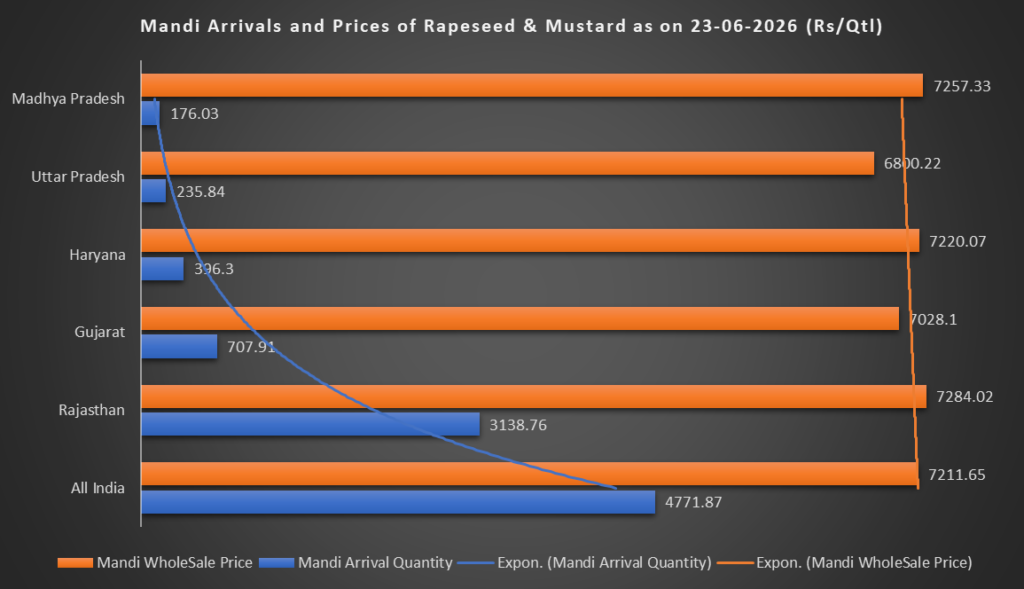
India’s rapeseed and mustard market continues to display a combination of strong price realization and concentrated supply dynamics, with Rajasthan emerging as the undisputed centre of market activity. According to the latest Agmarknet data, total mandi arrivals across the country stood at 4,771.87 metric tonnes (MT) on 23 June 2026, while the average wholesale price remained robust at Rs 7,211.65 per quintal, indicating sustained demand for the oilseed despite seasonal moderation in arrivals.
A closer examination of state-wise data reveals the overwhelming dominance of Rajasthan in the national mustard trade. The state accounted for 3,138.76 MT, or nearly 66 per cent of total arrivals reported across the country. This concentration reflects Rajasthan’s position as India’s largest mustard-producing state and underscores its influence on national price discovery. The average wholesale price in Rajasthan stood at Rs 7,284.02 per quintal, above the national average, indicating strong market sentiment and healthy demand for quality produce.
Among Rajasthan’s key markets, Todaraisingh APMC emerged as the premium pricing centre, reporting an average wholesale price of Rs 7,765 per quintal, the highest among all major mandis listed in the data. The market’s price premium suggests strong buyer interest, potentially driven by superior grain quality, active procurement or tighter local supplies. Khairthal APMC recorded substantial arrivals of 288.60 MT with prices at Rs 7,320 per quintal, while Rawla APMC handled 287 MT and reported prices of Rs 7,190 per quintal. The relatively narrow price variation across these markets points to a well-integrated trading environment within the state.
Gujarat emerged as the second-largest contributor to national arrivals with 707.91 MT, accounting for nearly 15 per cent of total supplies. However, the state’s average wholesale price of Rs 7,028.10 per quintal remained below both the national and Rajasthan averages. The lower pricing suggests either a different quality profile of arrivals or comparatively higher market availability. Among the leading mandis, Tharad APMC commanded the highest price at Rs 7,160 per quintal, followed by Diyodar APMC at Rs 6,977 per quintal and Dhanera APMC at Rs 6,940 per quintal. Despite strong arrivals, Gujarat’s markets remained among the more competitively priced centres in the country.
Haryana maintained a balanced market position, reporting arrivals of 396.30 MT and an average wholesale price of Rs 7,220.07 per quintal, slightly above the national average. The state’s pricing performance indicates steady demand and relatively tighter supply conditions compared with some neighbouring markets. Ateli APMC stood out by offering Rs 7,500 per quintal, making it one of the highest-priced mustard markets in northern India on the day. Rewari APMC, the state’s largest reporting market by volume, registered arrivals of 169.40 MT and prices of Rs 7,250 per quintal, while Adampur APMC reported prices of Rs 7,094 per quintal. The spread in prices across Haryana suggests differentiated demand patterns and localized supply conditions.
Uttar Pradesh presented a contrasting picture. Although arrivals stood at 235.84 MT, the state’s average wholesale price was Rs 6,800.22 per quintal, the lowest among the major mustard-producing states covered in the data. The relatively weaker price realization may indicate higher local availability, quality differences or softer procurement demand. However, individual market performance highlighted considerable variability. Khairagarh APMC recorded one of the highest mandi prices nationally at Rs 7,551 per quintal, significantly above the state average, while Auraiya APMC reported Rs 6,900 per quintal and Raath APMC recorded Rs 6,638 per quintal. Such disparities suggest that market-specific factors continue to play a major role in determining price outcomes.
Madhya Pradesh reported arrivals of 176.03 MT, making it the smallest contributor among the five major states analysed. Nevertheless, the state recorded an average wholesale price of Rs 7,257.33 per quintal, one of the highest state-level averages in the country. The data indicates a relatively tight supply environment combined with healthy demand. Sevda APMC emerged as the state’s premium market with prices touching Rs 7,530 per quintal, while Lahar APMC recorded Rs 7,260 per quintal and Lavkush Nagar (Laundi) APMC reported Rs 7,000 per quintal. The strong pricing despite lower arrivals suggests that buyers remain willing to pay a premium in select Madhya Pradesh markets.
The national market landscape reveals an important trend: price strength is being maintained even as arrivals remain heavily concentrated in a few producing regions. Rajasthan’s commanding share of arrivals continues to make it the principal determinant of national supply conditions, while states such as Haryana and Madhya Pradesh are achieving higher price realization through comparatively tighter market availability. At the same time, the significant differences in mandi-level prices within individual states point to localized demand-supply balances, quality considerations and procurement activity influencing market outcomes.
From a broader market perspective, wholesale mustard prices remaining above Rs 7,200 per quintal at the all-India level indicate continued resilience in the oilseed complex. Strong demand from edible oil processors, stable consumption patterns and expectations regarding future supplies appear to be supporting market sentiment. The ability of several mandis to command prices above Rs 7,500 per quintal further reflects buyer willingness to secure quality produce despite the seasonal progression of arrivals.
As the marketing season advances, market participants will closely monitor arrival trends from Rajasthan and other key producing states, as well as developments in edible oil demand and procurement activity. For now, the data points to a mustard market characterized by strong pricing fundamentals, regional concentration of supplies and sustained demand across major agricultural markets.
— Suchetana Choudhury (suchetana.choudhuri@agrospectrumindia.com)