Saturday, 13 June 2026

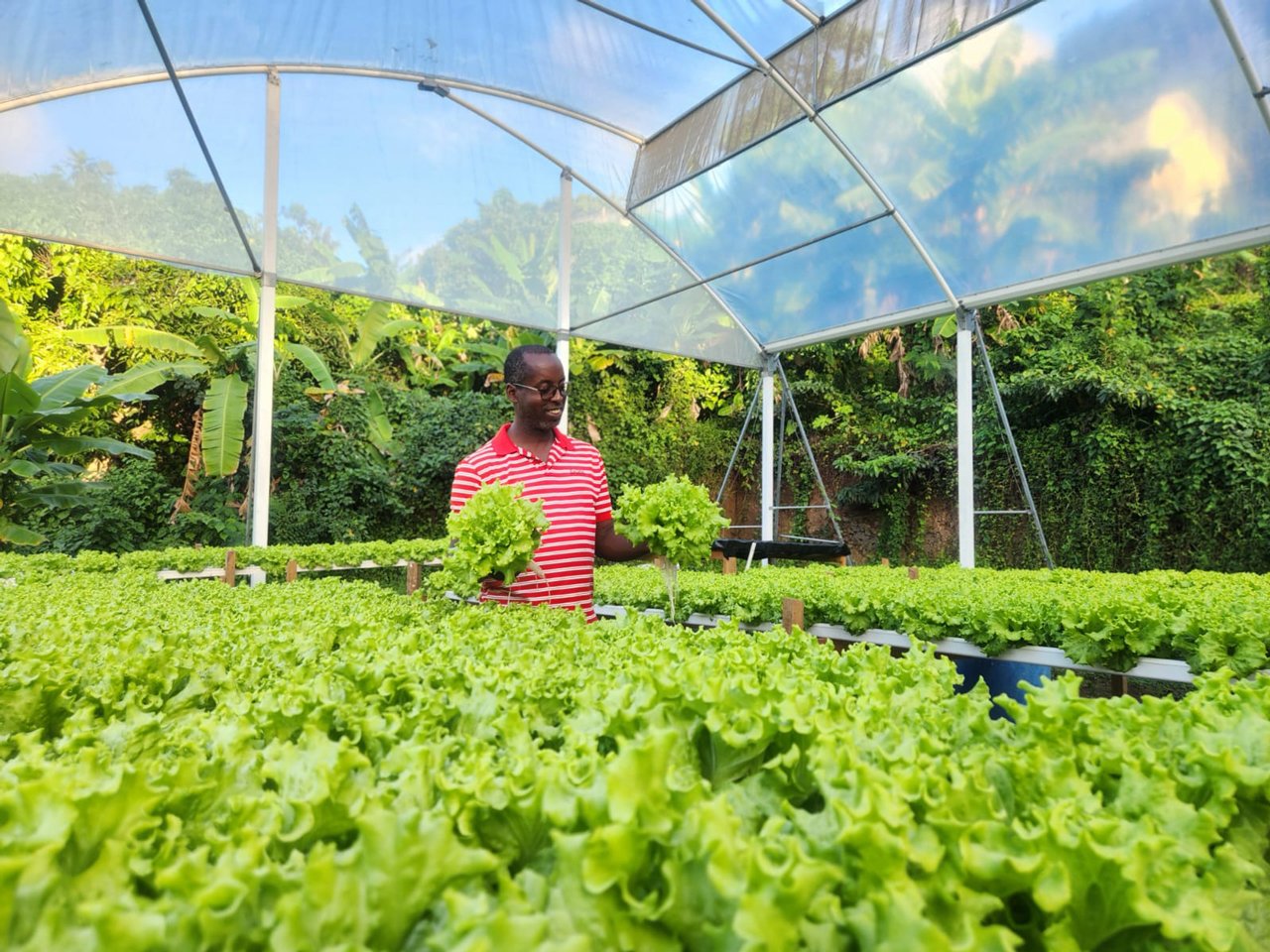
Photo courtesy: Josanne and Roger Benjamin
Hydroponics offers an innovative and climate-smart solution to family farmers in Grenada
Inside a small greenhouse on a family farm in southern Grenada, lettuce grows without soil, powered by the sun. The Benjamins (Roger, 41, and Josanne, who goes by Candy, 38) stand inside this shaded structure, watching the flow of water through a network of narrow pipes. The lettuce above looks familiar—bright, green, neatly spaced—but it grows with its roots suspended in a steady stream of nutrient-rich water instead of soil.
They did not set out to build something unique. They were trying to solve a problem. Rainfall arrived in bursts or went absent for weeks, and, because of climate change, each season carried more uncertainty than the last. Like many small farmers, they were working within tight margins, where a single failed crop could erase months of effort.
They began by teaching themselves. Roger spent evenings watching online videos and reading about how hydroponics might work in their conditions. What they built at first was simple— a shade house, a set of pipes and a basic monitoring system, adjusting as they learned.
The opportunity to enhance the system came through a readiness project implemented by the Food and Agriculture Organization of the United Nations (FAO) and funded by the Green Climate Fund (GCF). This was one of a series of project pilots designed to deliver evidence for adaptation planning in Grenada.
The couple received an improved system including a greenhouse, a robust hydroponic system, a solar pump, panel and batteries, as well as training on their use. This increased their production from about 500 heads of lettuce to roughly 1 300. The growth was significant (160 percent increase), but it also required a deeper understanding of how the more complex system functioned.
Compared with conventional cultivation, hydroponics uses up to 90 percent less water. As a climate adaptation technology, it also reduces exposure to soil-borne pests and allows more efficient use of space, inputs and labour. Crops such as lettuce, kale, spinach, herbs, peppers and tomatoes—fast-growing and high-value—are well suited to this method and can be harvested more frequently.
However, hydroponics depends on precision. The Benjamins use a method in which a thin layer of nutrient-rich water flows continuously through the pipes, feeding the plants as it passes. Getting that flow right proved to be one of the most difficult parts of the process.
If the gradient of the pipes is too steep, the flow is too fast and the roots do not receive enough nutrients; if it is too flat, it slows down and pools, meaning roots might not get sufficient oxygen. Learning how to design that balance took time, as did adjusting to the use of fertilizers designed specifically for hydroponic systems, which are more expensive than conventional inputs but last longer.
For the Benjamins, growing lettuce is only part of the equation. Finding a place in the market has been just as important. There is steady demand, but also strong competition from established growers. The farm now sells most of its lettuce to supermarkets, while also using social media channels to reach customers directly. Customers often return, Candy says, because they notice the consistency and freshness.
The couple is already thinking about diversifying. They would like to grow crops such as tomatoes, cabbage and cauliflower, but that requires adapting the hydroponics, including installing larger pipes to accommodate larger root varieties.
What the system offers, above all, is stability. In Grenada, climate extremes, including periods of heavy rainfall, can destroy crops through rot and fungus, while heat can dry out soils and reduce yields. Inside the covered structure, those pressures are reduced. The metal frame and ventilated design allow hot air to escape while protecting plants from excessive rain, creating a controlled environment where production can continue even under difficult conditions.
Running a hydroponic system does come with constraints. Electricity is one of them, since the pumps must operate continuously to maintain the flow of water, air and nutrients. To address this, the project provided solar panels, a solar pump and batteries, which have high initial capital cost but allow to keep operating costs manageable. This solution helps reduce emissions and expand farmer incomes.
Maintenance is relatively low, and monitoring the system takes about 30 minutes a day. The nature of the work has also shifted, requiring less physical strain than traditional farming, as there is no need to till soil or bend over for long periods.
The changes have drawn attention from the surrounding community. Other farmers have begun experimenting with hydroponics, and the Benjamins have shared what they have learned, helping several of them build similar systems and offering visits to their farm.
Looking ahead, Roger and Candy talk about a farm-to-table model, where customers can buy crops directly from their farm. They also want to continue sharing their experience more widely, drawing on what they learned through trial and error.
At the Benjamin’s family farm, the greenhouse and hydroponic system now run independently of the weather, preventing nutrients from being diluted and pests from proliferating. For the Benjamins, this shift has not only changed how they grow food, but how they think about what is possible on their land.
In addition to the climate-resilient pilots, FAO assisted the Government of Grenada by improving their data generation and management capacity for adaptation planning through a number of tools and instruments, namely, a knowledge management portal, a Climate Risk Atlas, a Standard Precipitation Index, a National Food Security Index and a Food and Nutrition Policy and Action Plan.
To read more click: https://www.fao.org/newsroom/story/no-soil-no-problem/en