Wednesday, 27 May 2026

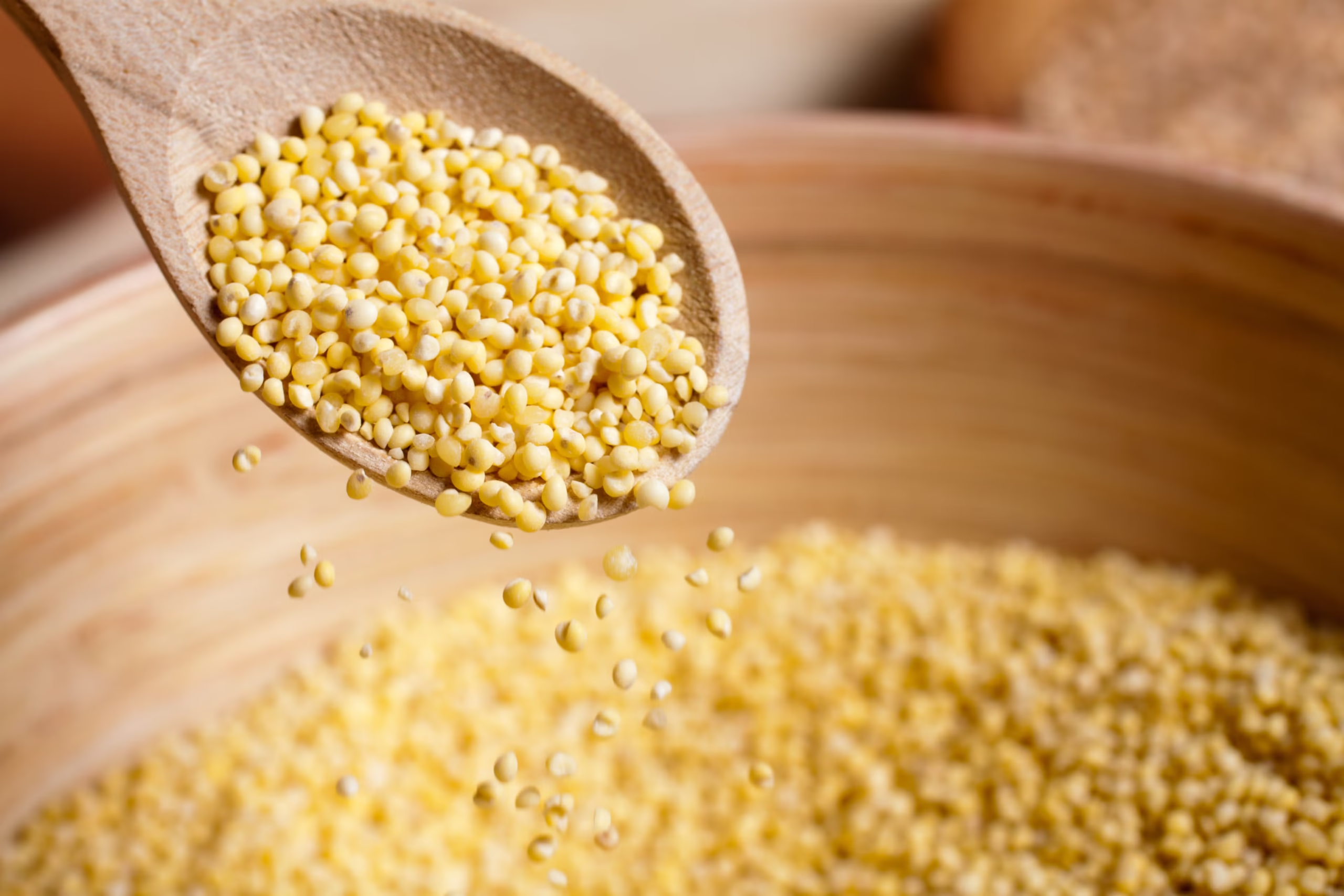
MoFPI’s targeted push places millets at the centre of value addition, entrepreneurship, and export growth
India’s long-neglected “nutri-cereals” are moving decisively from subsistence to scale.
Through a calibrated mix of production-linked incentives, district-level entrepreneurship support, and branding investments, the Ministry of Food Processing Industries (MoFPI) has approved Rs 793.27 crore in incentives to accelerate millet-based food processing across the country—marking one of the most significant industrial policy interventions for millets since the International Year of Millets (2023).
At the core of this push is the Production Linked Incentive Scheme for Food Processing Industry (PLISFPI), under which a dedicated Rs 800 crore outlay was earmarked for Millet-Based Products (MBP). As of December 2025, incentives have been approved for 29 enterprises, including 8 large firms and 21 small and medium enterprises, spanning ready-to-eat foods, value-added ingredients, and export-oriented formulations.
The objective is explicit: shift millets from raw grain markets into high-value consumer and export products, while anchoring manufacturing entirely within India.
A multi-layered policy architecture
MoFPI’s millet strategy extends well beyond headline incentives.
Under the PM Formalisation of Micro Food Processing Enterprises (PMFME) scheme, millet-based products have been designated as One District One Product (ODOP) in 21 districts, embedding millets into local enterprise ecosystems. As part of this effort:
Millet Mahotsavs were organised across 30 districts during IYoM 2023 to catalyse start-ups and micro-entrepreneurs
Rs 226.40 crore in loans has been sanctioned to 4,366 entrepreneurs engaged in millet processing
Branding and marketing support is being extended to FPOs, SHGs, cooperatives, and SPVs, enabling common packaging, quality standardisation, and food safety compliance for retail markets
Complementing this, under the Pradhan Mantri Kisan SAMPADA Yojana (PMKSY), one millet-based processing unit has been approved under the Creation/Expansion of Food Processing & Preservation Capacities (CEFPPC) component—signalling early-stage capacity building for larger industrial clusters.
From farmer resilience to export ambition
While the Ministry notes that no standalone study has yet quantified the direct impact on farmer incomes, the structural intent is clear. By pulling millets into organised value chains—processing, branding, and exports—the schemes aim to stabilise demand, improve price realisation, and reduce farmers’ exposure to climate and market volatility.
The export dimension is already visible. Agricultural processed food exports approved under PLISFPI have grown at a CAGR of 13.23 percent between 2019–20 and 2024–25, underscoring how value addition—not volume—has become India’s competitive lever.
Crucially, PLISFPI incentives are admissible only when the entire manufacturing chain is located in India, reinforcing domestic capacity creation while aligning with Atmanirbhar Bharat objectives.
A quiet transformation underway
Taken together, the Rs 793 crore milestone reflects more than budgetary deployment—it marks a strategic reimagining of millets as industrial, entrepreneurial, and export-ready commodities. From micro-units in ODOP districts to large processors building national brands, India’s millet economy is transitioning from policy symbolism to market substance.
The challenge ahead lies in closing the final loop: systematically linking these processing gains to measurable improvements in farmer incomes and regional resilience. If that bridge is built, millets may well become one of India’s most successful examples of climate-smart industrial agriculture.